Wednesday, September 17, 2008

U.S. regulators try to find WaMu buyer: report

This is off Yahoo News:

(Reuters) - U.S. federal regulators recently called a number of banks asking if they would consider buying Washington Mutual Inc (WM.N) should it eventually falter, the New York Post said, citing sources.

Federal banking regulators, in recent days, contacted Wells Fargo & Co (WFC.N), JPMorgan Chase & Co (JPM.N), HSBC (HSBA.L) and several other financial institutions to gauge their interest in a possible acquisition of WaMu, the paper said.

No merger discussions are currently under way between the Seattle-based bank and anyone else, the sources told the paper.

Washington Mutual could not be immediately reached for comment.

(Reporting by Ajay Kamalakaran in Bangalore; Editing by Paul Bolding)

So, are the Feds going to bail out WaMu?

And just to note, the Dow has now plunged 350 points today on the news of the Fed's buyout of AIG.

Fundamentally strong?

John McCain said our economy has been fundamentally strong for this past year:


And McCain adviser Phil Gramm still calls Americans a "bunch of whiners" for not believing in our fundamentally strong economy.

Tuesday, September 16, 2008

Obama campaign ad--Fundamentals

Here is Barack Obama's campaign ad, attacking John McCain for claiming that the "fundamentals" of the American economy are still strong, even as Lehman Brothers was going bankrupt. From YouTube:


This is not a bad 30-second ad to attack McCain on. This is the way you attack John McCain on the economy. You hammer at him with his own words, showing just how clueless John McCain is when confronted with complex economic issues. You also attack McCain's lies and hypocrisy on the issues of deregulation and government oversight. You link McCain with Phil Gramm, and Gramm's own involvement in destroying the wall between banks and investment firms which caused this subprime mortgage mess in the first place. And finally, you always show a picture of McCain with Bush, constantly reinforcing in the American voters' minds that John McCain is running for a third Bush term.

And finally, you keep attacking McCain again and again.

Tuesday Night Music Video--REM's It's the End of the World

With the insanity of Wall Street jitters and presidential campaign jangles, I think it is a great time for a music video. And what is a better way to celebrate such jitters and jangles than REM's It's the End of the World. From YouTube:


And I feel fine.

Fed loans $85 billion to AIG for 80 percent stake

Oh My God! This is just--wow! Wow! Wow! From the New York Times:

In an extraordinary turn, the Federal Reserve was close to a deal Tuesday night to take a nearly 80 percent stake in the troubled giant insurance company, the American International Group, in exchange for an $85 billion loan, according to people briefed on the negotiations.

All of A.I.G.’s assets would be pledged to secure the loan, these people said, and in return, the Fed would receive warrants that could be exchanged for an ownership stake. Stock of existing shareholders would be diluted, but not wiped out.

A person briefed on the matter said the agreement does not require shareholder approval.

If the Fed takes a controlling stake, it is likely that it would want to replace A.I.G.’s board as well as its chief executive and chairman, Robert B. Willumstad.

The Fed’s action came after Treasury Secretary Henry M. Paulson and Ben S. Bernanke, president of the Federal Reserve, went to Capitol Hill on Tuesday night to meet with House and Senate leaders. Mr. Paulson called the Senate majority leader, Harry Reid, Democrat of Nevada, about 5 p.m. and asked for a meeting in the Senate leader’s office, which began about 6:30 p.m.

The Federal Reserve and Goldman Sachs and JPMorgan Chase had been trying to arrange a $75 billion loan for A.I.G. to stave off the financial crisis caused by complex debt securities and credit default swaps. The Federal Reserve stepped in after it became clear Tuesday afternoon that the banking consortium could not complete the deal in time.

Without the help, A.I.G. was expected to be forced to file for bankruptcy protection.

The need for the loans became necessary after the major credit ratings agencies downgraded A.I.G. late Monday, a move that likely to have forced the company to turn over billions of dollars in collateral to its derivatives trading partners worsening its financial health.

Until this week, it would have been unthinkable for the Federal Reserve to bail out an insurance company, and A.I.G.’s request for help from the Fed of just a few days ago was rebuffed.

But with the prospect of a giant bankruptcy looming — one with unpredictable consequences for the world financial system — the Fed abandoned precedent and agreed to let the money flow.

Attending the meeting on the Capitol Hill were Democratic Senate leaders that included Charles E. Schumer of New York, Richard J. Durbin of Illinois, Christopher J. Dodd of Connecticut and Kent Conrad of North Dakota A contingent of Republicans was led by Mitch McConnell of Kentucky, the minority leader, and included Richard C. Shelby of Alabama, Jon Kyl of Arizona and Judd Gregg of New Hampshire. House leaders included John Boehner of Ohio, the Republican leader; Spencer Bachus, Republican of Alabama; and Barney Frank, Democrat of Massachusetts. Members of the leaders’ staffs were asked to leave the meeting shortly after it began.

I don't know where to begin--this is so unprecedented. The U.S. government has taken control of a major Wall Street insurance and investment corporation. The first quick comment I can see is that if the Fed takes control of AIG, then you can bet that the board and AIG's CEO, Robert B. Willumstad, will be fired. I'd say fire the board and Willumstad now, and don't allow Willumstad to walk away with his golden parachute.

The second comment I have is who will be next? By taking control of AIG, the Fed is now telling Wall Street that if you go bankrupt due to the subprime mortgage mess, we will bail you out and take control of your investment firm. So who will be the next company in the Fed's new investment portfolio? Will Washington Mutual become the next casualty to be taken over by the Fed? Will Citigroup become the next casualty?

I found this U.S. News and World Report story, showing the top ten biggest U.S. banks that have gone into failure:

1. Continental Illinois National Bank and Trust, Chicago (1984)
Total assets: $40.0 billion

2. First Republic Bank, Dallas (1988)
Total assets: $32.5 billion

3. American S&LA, Stockton, Calif. (1988)
Total assets: $30.2 billion

4. Bank of New England, Boston (1991)
Total assets: $21.7 billion

5. MCorp, Dallas (1989)
Total assets: $18.5 billion

6. Gibraltar Savings, Simi Valley, Calif. (1989)
Total assets: $15.1 billion

7. First City Bancorporation, Houston (1988)
Total assets: $13.0 billion

8. Homefed Bank, San Diego (1992)
Total assets: $12.2 billion

9. Southeast Bank, Miami (1991)
Total assets: $11.0 billion

10. Goldome, Buffalo (1991)
Total assets: $9.9 billion

Continental Illinois National Bank and Trust was seized by the Fed in 1984 with total assets of $40 billion. American Income Group has total assets of over $1 trillion dollars. This is huge. And we're not even through with the financials reporting write-downs and losses due to the subprime mortgage collapse.

How many more banks are going to fail? How many more banks will the Fed take control of?

Daily Palin Headliners

I don't know what else I can say about Republican vice presidential candidate Sarah Palin, except that she is vindictive, corrupt, dishonest, and especially petty. And all the time, she hides under this image of a Hockey Mom / Mrs Smith Goes to Washington. However, the news reports coming out on the Troopergate scandal shows what a fraud Palin really is.

So here is another does of the Daily Palin Headliners.

McCain campaign says Palin will not talk to Troopergate investigator: ThinkProgress is reporting that Sarah Palin will not talk to the investigator hired by the Alaskan state legislator to look into the Palin firing of her public safety commissioner. This is no big surprise, since the McCain campaign has refused to cooperate with the investigation, claiming that it was tainted by politics, despite the fact that the five-member committee is composed of three Republicans and two Democrats. So the question remains now, when is the Alaskan state legislator going to subpoena Palin?

Lawmakers sue to stop Palin Troopergate scandal: Time.com is reporting that five state Republican lawmakers are asking an Anchorage Superior Court judge to stop the investigation into Alaska Gov. Sarah Palin's firing of a public safety commissioner. I'm starting to wonder if these state Republican lawmakers have been talking to the McCain campaign in trying to stuff the Troopergate investigation.

Palin claims executive privilege to conceal emails: ABC News is reporting that Alaskan Gov. Sarah Palin is citing executive privilege to withhold emails from public view. The problem here is that Sarah Palin used private Yahoo email accounts to conduct state business, raising questions of a backdoor secrecy within the Palin administration. You can bet that Vice President Palin will continue this policy of email secrecy.

Sarah Palin shows just how to respond to reporters' questions: This is from the Associated Press;


DAYTON, Ohio (AP) — Asked about her refusal to turn over e-mails to an Alaska investigator, Republican vice presidential candidate Sarah Palin looked up, smiled — and then stepped wordlessly into her waiting car.

Sarah Palin will never attend any press conferences, and will never answer questions to reporters before, or after, McCain-controlled campaign events. According to the AP story:

Since departing Alaska on Saturday for her first solo campaign trip, Palin has spoken before two rallies and appeared at a fundraiser.

After a speech in Carson City, Nev., on Saturday, she flew to Denver and made no public appearances on Sunday. She spoke in Colorado on Monday morning, then held her first solo fundraiser later in the day in Ohio. One scheduled interview was postponed due to storm-related damage. She has refused to answer shouted questions about issues ranging from the economy to the home-state investigation.

Aides keep reporters well away from her when she is campaigning, and also protect her privacy aboard her chartered campaign plane by pulling a curtain across the center aisle to separate the Palins and her top aides from the rest of the passengers.

The McCain campaign is completely hiding Sarah Palin, making her into a Toy Poodle to perform in John McCain's dog and pony show.

Sarah Palin can't keep her Troopergate story right: TPM Muckraker is reporting that Sarah Palin has given three contradictory stories on why she fired Public Safety Commissioner Walt Monegan. The first story is that Palin fired Monegan because "of a series of instances of Monegan's insubordination on budget issues, including Monegan working with an Alaska legislator to seek funding for a project Governor Palin had already vetoed." The second story of why Palin fired Monegan is because 'Monegan was the "chief proponent" for an "ambitious, multi-million dollar initiative to seriously tackle sex crimes in the state," and that Palin's office "put the plan on hold in July," just days before Monegan's firing.' And the third story of why Palin fired Monegan was because Palin "was dissatisfied with his performance on filling vacant trooper positions and on bootlegging and alcohol abuse issues." And let us not forget that Palin told The New Yorker that she didn't fire Monegan, but rather she had "wanted to reassign him to combat alcohol abuse, and that he quit instead."

Which story is it?

Of course, The Washington Post has published emails showing that Palin had written to Monegan, expressing frustration that Monegan would not fire Palin's brother-in-law, who was the Alaskan state trooper involved in a divorce with Palin's sister.

Now Palin is claiming she fired Monegan for being too aggressive in combating sex offenders: TPM Muckraker has fourth reason for why Alaska Gov. Sarah Palin fired Public Safety Commissioner Walt Monegan--he was being too aggressive in combating child molesters;

McCain's campaign insists the investigation into the firing of Public Safety Commissioner Walt Monegan has been hijacked by Democrats. The campaign says it can prove Monegan was fired in July because of insubordination on budget issues, and not because he refused to fire a state trooper who went through a nasty divorce from Palin's sister.

To that end, the campaign released a series of e-mails detailing the frustration several Palin administration officials experienced in dealing with Monegan. The "last straw," the campaign said, was a trip Monegan planned to Washington in July to seek federal money for investigating and prosecuting sexual assault cases.

In a July 7 e-mail, John Katz, the governor's special counsel, noted two problems with the trip: the governor hadn't agreed the money should be sought, and the request "is out of sequence with our other appropriations requests and could put a strain on the evolving relationship between the Governor and Sen. Stevens."

Monegan was fired four days later.

That Walt Monegan is just a really bad employee for Sarah Palin.

Top McCain economic adviser claims that McCain & Palin not qualified to run major corporation: Americablog has this YouTube video showing McCain adviser, and former Hewlett Packard CEO, Carly Fiorina saying that both John McCain and Sarah Palin are not qualified to run a major corporation. From YouTube;


So if John McCain and Sarah Palin are not qualified to run a major corporation, what makes them qualified to run the U.S. government?

Fiorina actually repeated this statement of Sarah Palin not being qualified for running a major U.S. corporation twice--Once on Fox News, and again on KTRS in St. Louis. From YouTube:


So why is Sarah Palin qualified to run as Vice President of the United States?

Sarah Palin repeats a teleprompter lie: This is from The Washington Monthly, sourcing a Wall Street Journal story on how Sarah Palin repeated a story at an Ohio country club of how a broken teleprompter caused her to ad-lib much of her acceptance speech at the Republican National Convention:

On Monday afternoon Gov. Palin and her entourage tooled through neighborhoods still without power in storm-stricken Stark County, Ohio, where she attended a fundraiser at the Brookside Country Club.

The governor’s first “funder” raised just under $1 million. Gov. Palin raised questions among the traveling press — confined under police guard for most of her three-hour visit inside a club boardroom — by telling her patrons the Tricky Tale of the Teleprompter Triumph.

As recorded by a reporter allowed to observe the 35-minute fundraiser appearance, this was the first time Gov. Palin herself relayed the story of how a fouled-up teleprompter forced her to ad-lib big swaths of her acclaimed acceptance speech at the Republican Convention Sept. 3.

But that story has been largely debunked. Reporters who saw the equipment that night say –and the party has not denied — that any teleprompter issue was minor at most. In the days after the event it was touted — on a hush-hush, off the record basis — by top Republicans as a way to show how swift-thinking is their newest star, despite her avoidance of any and all unscripted moments on the trail.

Gov. Palin’s telling was a Canton crowd-pleaser: “There Ohio was right out in front, right in front of me. The teleprompter got messed up, I couldn’t follow it, and I just decided I’d just talk to the people in front of me,” she said. “It was Ohio.”

Sarah Palin has lied repeatedly about the Bridge to Nowhere. Sarah Palin has lied about the federal earmarks. She has lied about firing Walt Monegan. She and John McCain have lied about selling the jet on eBay. The McCain campaign has lied about Sarah Palin being in Iraq. Lies after lies after lies. Given the McCain campaign's penchant for lying about everying--big and small--why should we believe anything that comes out of Sarah Palin's mouth?

Or even John McCain's mouth?

Stocks rise as Fed keeps interest rates steady, pumps $70 billion in financial system

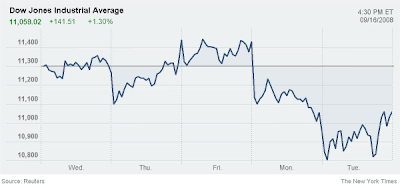
There is a lot of news coming out on the financial markets today. I'm going to start with the stock market news, where the Dow gained 140 points today:

NEW YORK - Wall Street ended another tumultuous session with a sizable gain Tuesday, partly recovering from its worst sell-off in years after the Federal Reserve said it was keeping interest rates steady. The central bank soothed fears of a worsening financial crisis even as the market waited to learn the fate of troubled insurer American International Group Inc.

In a statement accompanying its decision, the Fed noted the growing strains in the financial markets a day after the Dow Jones industrials plunged 504 points in reaction to continuing turmoil in the financial sector. The Fed also noted the ongoing weakening of the labor market. But it also sought to give some reassurance by saying it expected its policy moves to foster moderate economic growth over time.

The Fed has cut its target federal funds rate by 3.25 percentage points to its current level of 2 percent over the past year. Many on Wall Street expected the Fed to keep rates steady but there was some hope that the central bank would try to calm uneasy financial markets with a rate cut.

According to preliminary calculations, the Dow rose 141.51, or 1.30 percent, to 11,059.02, after falling about 100 points immediately after the Fed announcement. The Dow at turns rose and fell as much as 175 points in fractious trading; on Monday, it suffered its largest drop since the September 2001 terror attacks.

Broader stock indicators advanced. The Standard & Poor’s 500 index rose 20.90, or 1.75 percent, to 1,213.60, and the Nasdaq composite index rose 27.99, or 1.28 percent, to 2,207.90.

Dow Jones one week chart. From NY Times

Wall Street traders were hoping for any good news to come today, after the weekend worries of Lehman Brothers bankruptcy, Merrill Lynch's sale to Bank of America, and AIG's continued deteriorating financial condition. The wet dream for Wall Street was a potential Federal Reserve rate cut, however the Fed decided to keep the rate as is. In keeping interest rates as they were, Wall Street decided that was good enough news for today.

And there was more good enough news to provide something of a Wall Street rally. The Federal Reserve pumped $70 billion into the financial system today:

WASHINGTON - Urgently trying to keep cash flowing amid a Wall Street meltdown, the Federal Reserve on Tuesday pumped another $70 billion into the U.S. financial system to help ease credit stresses.

Chart showing Federal Reserve benchmark for the year. From NY Times

The Federal Reserve Bank of New York's action came in two operations in which $50 billion and then another regularly scheduled $20 billion were injected in temporary reserves.

The cash infusion Tuesday was designed to help ease a spike in the overnight lending rate between banks. A sharp rise in such borrowing costs makes banks reluctant to lend to each other and to hoard cash, worsening already tight credit conditions. Harder-to-get credit has crimped spending by consumers and business, a factor in the slowing economy.

[....]

In the last few days, the American financial system has been badly shaken as bad bets on dodgy mortgage-backed securities claimed more Wall Street giants.

[....]

To help grease the financial plumbing Monday, the Fed pumped a total of $70 billion into the system through open market operations.

So, Wall Street was worried about the bad debt, and the derivative gambling taking place which have shaken Lehman Brothers, Merryll Lynch, and AIG. And there is certainly more worries that other banks and investment firms could get into trouble if they can't finance their derivative contracts, or their mortgage-backed securities. So this becomes another piece of good news for Wall Street traders to rally to stock market.

The problem here is that this is a short-term rally, in the face of a long-term problem. According to The New York Times, the Fed is caught in "an epic crisis of confidence in financial markets and stalling growth on the one hand, and persistent if less dramatic inflation pressures on the other." Investors reacted at first at the news of the Fed's leaving interest rates unchanged by sending the Dow down "by almost a full percentage point immediately after the announcement." But then traders decided this wasn't such bad news after all, since Wall Street was originally expecting the Fed to keep interest rates steady. The stock market was reacting jittery over any financial news, considering the crisis that has rocked Wall Street over the past weekend. This was a crisis in confidence. California State University, Channel Islands' economist Sun Won Sohn said, “The F.O.M.C. has decided to stand pat despite the market turmoil. “Lower interest rates at this time would not solve any problems in the financial markets. The market is not short of liquidity; it is short of confidence.”

And this lack of confidence will continue to roil the financial markets. Fed officials will be meeting in New York to determine the fate of American International Group, "which may need up to $75 billion to shore up its books." There is talk of a Fed-arranged loan package for AIG, but no one is commenting on such a proposal. The Federal Reserve faces "the uncomfortable fact that interest rates have little to do with a credit crisis that stems from staggering losses on poorly underwritten mortgages and mortgage-backed securities." AIG doesn't need a cut in the interest rate of their loans, AIG needs money to cover their losses stemming from the bad bets made on the subprime mortgage investments. According to the NY Times:

The unanimous decision surprised many analysts and investors, who had expected the Fed to bolster confidence with another flood of cheap money. But some economists said the decision reflected the unhappy truth that a cut in the overnight Federal funds rate might have merely highlighted the Fed’s limited ability to solve a problem that entails the entire housing and mortgage markets.

“The financial markets aren’t frozen because the Federal funds rate is too high,” said Michael Darda, chief economist at MKM Partners, an investment firm in Greenwich, Conn. “The markets are frozen because there is a crisis of confidence. It’s not a matter of whether the short rate is 2 percent or 1.5 percent.”

Below the surface, the Fed continued to flood the markets with extra cash through its open-market operations in New York. On Tuesday morning, the Fed injected an additional $50 billion into the markets simply to keep the Federal funds rate at its target level of 2 percent. The funds rate had climbed as high as 4 percent when markets opened.

This brings up another problem for the Federal Reserve. Look at how the markets reacted to the financial crisis in regards to the funds rate--it climbed as high as 4 percent when the markets opened. Banks are not willing to loan money out to financial firms facing problems with their balance sheets due to the bad sub-prime mortgage investments. After the credit agencies downgraded AIG's credit rating, AIG was forced to post collateral from $10-13 billion. It is not that there is no liquidity out there, but that banks are not handing out loans to institutions unless they have platinum-plated credit ratings. So instead of cutting the federal funds rate, the Fed has been pumping even more money into the financial system simply to keep the interest rates down to 2 percent, even as banks are refusing to release the money out into the market. If the Federal Reserve did not release the $50 billion into the financial market, money in the credit market would continue to dry up, sending interest rates even higher.

The day of reckoning is still coming.

Alaska Gov. Sarah Palin had tanning bed installed in governor's mansion

You know, it is one thing for the McCain campaign to be calling Barack Obama an "elitist," or Republican vice presidential candidate Sarah Palin calling Obama "a member in good standing of the Washington elite," however, you better make sure that in engaging in elitist attacks, you don't expose yourself to your own hypocrisy.

Which is exactly what Sarah Palin has done. From The Huffington Post:


Al Giordano of Narco News first reported that Sarah Palin has a tanning bed installed in the Alaska Governor's Mansion:

"The governor did have a tanning bed put in the Governor's Mansion," Roger Wetherell, chief communications officer of Alaska's Department of Transportation and Public Facilities, confirmed to this newspaper. "It was done shortly after she took office [in early 2007] and moved into the mansion."

Ben Smith of the Politico confirmed the report.

"She paid for it with her own money," Wetherell told Smith in an email.

UPDATE: US Weekly has more:

According to Wetherell, the tanning bed was purchased used, from a health club.

Tanning beds can cost up to $35,000 to install in a home - not including the cost of parts, Color Me Tan manager Erin Weise told the Narco News.


"I don't think it's normal for people to have a tanning bed in their house, " Wiese, who is based in Fairbanks said. "It's expensive."

Palin's running mate, presidential candidate John McCain battled skin cancer in 1993, and again in 2000.

"I coat SPF 30 on myself first thing in the morning, and wear long sleeves and a hat whenever I'm in the sun," McCain has told Newsweek.

Palin declared May 2007, "Skin Cancer Awareness Month." In the press materials it was noted, "Skin cancer is caused, overwhelmingly, by over-exposure to ultraviolet radiation from the sun and from tanning beds."

Now I really do not care if Sarah Palin wants to have a tanning bed in her governor's mansion, however owning such an expensive, frivolous, piece of equipment also shows just how out-of-touch, and elitist, Sarah Palin is. It is more hypocrisy coming from the McCain/Palin campaign.

John McCain created the Blackberry, cell phone, and wi-fi

I really don't know what to say about this. From The Politico, via Americablog:

Asked what work John McCain did as chairman of the Senate Commerce Committee that helped him understand the financial markets, the candidate's top economic adviser wielded visual evidence: his BlackBerry.

"He did this," Douglas Holtz-Eakin told reporters this morning, holding up his BlackBerry. "Telecommunications of the United States is a premier innovation in the past 15 years, comes right through the Commerce Committee. So you're looking at the miracle John McCain helped create and that's what he did."

Al Gore, call your office.

And John McCain even created the cell phones and wi-fi. From The Daily Kos, via Americablog:

I am the former chairman of the Senate Committee on Commerce, Science and Transportation. The Committee plays a major role in the development of technology policy, specifically any legislation affecting communications services, the Internet, cable television and other technologies. Under my guiding hand, Congress developed a wireless spectrum policy that spurred the rapid rise of mobile phones and Wi-Fi technology that enables Americans to surf the web while sitting at a coffee shop, airport lounge, or public park.

Here is what Scientific American says about John McCain's inventive genius:

His running mate may be raising the ire of scientists with her positions on creationism and wildlife conservation, but Republican presidential nominee John McCain is touting his tech cred. In a page out of the Al Gore playbook, McCain boasts that "under my guiding hand, Congress developed a wireless spectrum policy that spurred the rapid rise of mobile phones and Wi-Fi technology."

McCain's remark today was in response to 14 science-policy questions posed to him and Democratic opponent Barack Obama. The Arizona senator's replies are published online by Science Debate 2008, a group of science and business leaders. (Obama answered the group's queries about three weeks ago.)

Gore, of course, famously contended that he "took the initiative in creating the Internet" — a comment mocked 'round the world. Now, McCain says he's "uniquely qualified to lead" America in technology because of his work with scientists and engineers during his Navy service from 1959 – 1981. In addition to his role in the wi-fi/cell phone revolution, McCain chaired the Committee on Commerce, Science and Transportation (from 1997-2001 and again from 2003-2005) when Republicans controlled Congress.

McCain's campaign didn’t immediately respond to an email seeking clarification on what wireless policy the senator is referring to, or his role in it.

So while the Republicans ridiculed Al Gore, when Gore stated he invented the Internet, we're suppose to praise John McCain for inventing Blackberries, cell phones, and wi-fi?

Obama's response to the Wall Street crisis

I do want to say something about Democratic presidential candidate Barack Obama's response to the Wall Street crisis. This is from The New York Times:

Mr. Obama sought Monday to attribute the financial upheaval to lax regulation during the Bush years, and in turn to link Mr. McCain to that approach.

“I certainly don’t fault Senator McCain for these problems, but I do fault the economic philosophy he subscribes to,” Mr. Obama told several hundred people who gathered for an outdoor rally in Grand Junction, Colo.

Mr. Obama set out his general approach to financial regulation in March, calling for regulating investment banks, mortgage brokers and hedge funds much as commercial banks are. And he would streamline the overlapping regulatory agencies and create a commission to monitor threats to the financial system and report to the White House and Congress.

On Wall Street’s Republican-friendly turf, Mr. Obama has outraised Mr. McCain. He has received $9.9 million from individuals associated with the securities and investment industry, $3 million more than Mr. McCain, according to the Center for Responsive Politics, a watchdog group. His advisers include Wall Street heavyweights, including Robert E. Rubin, the former treasury secretary who is now a senior adviser at Citigroup, another firm being buffeted by the financial crisis.

A couple of points here. First, Wall Street is starting to give more to Barack Obama than John McCain. My thinking here is that Wall Street is betting that Obama will be elected president, and the campaign contributions are a means for the Street to ask Obama to go easy on the increased federal regulations. I don't know what a President Obama will do with increasing federal regulations and oversight into the financial markets, but it certainly seems to be a better approach than the disastrous eight years of Bush deregulation, or McCain's call for a "9/11 style" economic commission that will do nothing.

And this financial crisis, caused by the subprime mortgage collapse, is just getting worst. American International Group is now on the verge of collapse. And even though the Federal Reserve is refusing to bail out AIG, and AIG bankruptcy is going to send an even greater shock wave through Wall Street, potentially sending even more banks and investment firms into their own financial crisis, and possibly their bankruptcies. I'm thinking that in 2009, the American taxpayer will be picking up the tab on this financial mess, regardless of who is elected in the White House. So the question now is, do you want the taxpayer to pick up the tab on a financial industry that will continue to remain deregulated, and Wall Street greedy business as usual, under a McCain administration? Or do you want the taxpayer to pick up the tab on a financial industry that will have stronger federal regulations and oversight under an Obama administration?

The choice is yours.

Palin continues to lie on her Bridge to Nowhere

I found this YouTube video via the Washington Monthly:

McCain proposes a "9/11 style" commission for U.S. economy

I don't even know where this bizarre McCain pledge will lead to. From ABC News:

An angry Sen. John McCain indicated today that as president he would launch a 9/11-commission style investigation into what he called "the old-boy network and Washington corruption" that created the current Wall Street crisis and has endangered peoples' savings and retirement funds.

McCain's stance on the economy has been under attack from Democrats since he released an ad Monday that said the economy was in crisis, but later gave a speech saying the "fundamentals of our economy are strong." He defended himself Tuesday and laced into a denunciation of corporate greed.

"I said the fundamental of our economy is the American worker. I know that the American worker is the strongest, the best, and most productive and most innovative," McCain, R-Ariz., told ABC's Chris Cuomo on "Good Morning America" Tuesday.

"They've been betrayed by a casino on Wall Street of greedy, corrupt excess -- corruption and excess that has damaged them and their futures," he added.

McCain said he wants an inquiry into what led to the current mess, though he did not offer details.

"We're going to need a '9/11 Commission' to find out what happened and what needs to be fixed," he said. "I warned two years ago that this situation was deteriorating and unacceptable. And the old-boy network and the corruption in Washington is directly involved, and one of the causes of this financial crisis that we're in today. And I know how to fix it, and I know how to get things done."

"Americans are hurting right now, and there's going to be a ripple effect of this financial crisis because of the greed and corruption and excess, and Wall Street treated the American economy like a casino," he continued. "And we can fix it, and we've got to keep people in their homes."

But let us speculate on McCain's "9/11-style" economic commission. President McCain convenes this blue-ribbon, economic commission. The commission reports that federal regulators were asleep at the switch, as the housing bubble grew. Wall Street became greedy in pushing the subprime mortgage securities int he market. The bubble collapsed, resulting in huge write-downs and losses to Wall Street investment firms. The McCain economic commission will say that it was the market's fault for the excessive behavior in pursuing the housing bubble and the subprime mortgage securities industry. There will be no criticism on President McCain's role in supporting deregulation of the housing industry, or Treasury Secretary Phill Gramm's role in repealing Depression-era federal regulations separating banks from investment firms. It was the free market's fault. The commission will say that it is the free market's responsibility for correcting this crisis, however the commission will recommend some token federal actions to politically suggest that the government is taking action to correct this crisis. Even worst, the commission might just recommend even more federal deregulation of the investment markets, saying that such deregulation would allow the free market to solve this crisis. In the end, nothing will come from this McCain economic commission investigation. This is all speculation as to whether President McCain would even honor his campaign promise to convene such a commission. More than likely, President McCain would ignore this campaign promise.

The foxes continue guarding the hen house.

Update: Democratic presidential candidate Barack Obama just blasted McCain over his economic commission. From YouTube:

McCain: The fundamentals of our economy are strong

In light of the Lehman Brothers bankruptcy, the AIG worries, and the Dow's 500-point drop, it is refreshing to know that Republican presidential candidate John McCain still believes that the fundamentals of the U.S. economy are still strong--as long as McCain gets to decide what those fundamentals are. From ThinkProgress:

During a campaign stop today in Orlando, FL, Sen. John McCain (R-AZ) attempted to defend his repeated claims that the “fundamentals of our economy are strong” by redefining those fundamentals as “workers and small businesses.” “The American worker and their innovation and their entrepreneurship, the small business, those are the fundamentals of America and I think they’re strong,” he said. Watch it:


As Atrios notes:

McCain has now defined the fundamentals of the economy as "workers and small businesses," so if you suggest something is wrong with the economy you're insulting workers. This follows the Bush strategy of saying that criticizing his Iraq policies is insulting the troops.

The real issue here is that John McCain doesn't have a clue as to how to solve the financial meltdown that is currently taking place on Wall Street. John McCain is running on a Bush economic policy of extending the Bush tax cuts and continuing the government deregulation of everything. Consider this New York Times article, titled In Candidates, 2 Approaches to Wall Street:

On the campaign trail on Monday, Mr. McCain, the Republican presidential nominee, struck a populist tone. Speaking in Florida, he said that the economy’s underlying fundamentals remained strong but were being threatened “because of the greed by some based in Wall Street and we have got to fix it.”

But his record on the issue, and the views of those he has always cited as his most influential advisers, suggest that he has never departed in any major way from his party’s embrace of deregulation and relying more on market forces than on the government to exert discipline.

While Mr. McCain has cited the need for additional oversight when it comes to specific situations, like the mortgage problems behind the current shocks on Wall Street, he has consistently characterized himself as fundamentally a deregulator and he has no history prior to the presidential campaign of advocating steps to tighten standards on investment firms.

He has often taken his lead on financial issues from two outspoken advocates of free market approaches, former Senator Phil Gramm and Alan Greenspan, the former Federal Reserve chairman. Individuals associated with Merrill Lynch, which sold itself to Bank of America in the market upheaval of the past weekend, have given his presidential campaign nearly $300,000, making them Mr. McCain’s largest contributor, collectively.

John McCain may champion himself on the political campaign trail as a reformer and an agent of "change," but his record and earlier statements show this to be a lie. When the Republicans took control of Congress in 1995, McCain "promoted a moratorium on federal regulations of all kinds. He was quoted as saying that excessive regulations were “destroying the American family, the American dream” and voters “want these regulations stopped.” The moratorium measure was unsuccessful.' McCain told the Wall Street Journal last March, "“I’m always for less regulation,” however, "I am aware of the view that there is a need for government oversight” in situations like the subprime mortgage mess. But McCain still stated that, "I am fundamentally a deregulator." In August, McCain gave a speech on the housing crisis, calling for less regulation, saying “Our financial market approach should include encouraging increased capital in financial institutions by removing regulatory, accounting and tax impediments to raising capital.”

And let us also not forget about McCain's closest economic adviser, former Senator Phil Gramm, and his own role in causing this housing crisis:

The general co-chairman of John McCain’s presidential campaign, former Sen. Phil Gramm (R-Texas), led the charge in 1999 to repeal a Depression-era banking regulation law that Democrat Barack Obama claimed on Thursday contributed significantly to today’s economic turmoil.

“A regulatory structure set up for banks in the 1930s needed to change because the nature of business had changed,” the Illinois senator running for president said in a New York economic speech. “But by the time [it] was repealed in 1999, the $300 million lobbying effort that drove deregulation was more about facilitating mergers than creating an efficient regulatory framework.”

Gramm’s role in the swift and dramatic recent restructuring of the nation’s investment houses and practices didn’t stop there.

A year after the Gramm-Leach-Bliley Act repealed the old regulations, Swiss Bank UBS gobbled up brokerage house Paine Weber. Two years later, Gramm settled in as a vice chairman of UBS’s new investment banking arm.

Later, he became a major player in its government affairs operation. According to federal lobbying disclosure records, Gramm lobbied Congress, the Federal Reserve and the Treasury Department about banking and mortgage issues in 2005 and 2006.

During those years, the mortgage industry pressed Congress to roll back strong state rules that sought to stem the rise of predatory tactics used by lenders and brokers to place homeowners in high-cost mortgages.

For his work, Gramm and two other lobbyists collected $750,000 in fees from UBS’s American subsidiary. In the past year, UBS has written down more than $18 billion in exposure to subprime loans and other risky securities and is considering cutting as many as 8,000 jobs.

Gramm did not respond to an e-mail and was unavailable for comment, according to a UBS spokesman. The bank has no official position on the subprime crisis, the spokesman said, but is a member of the Financial Services Roundtable and other industry groups that are actively lobbying Congress on the issue.

Now, some housing experts and economists see Gramm’s thinking in the recent housing proposal from McCain, the Republican Party’s presumed presidential nominee. Gramm is often a surrogate for the Arizona senator, particularly in meetings focused on the economy. And McCain has hinted he’d consider the former Texas senator for Treasury secretary in a McCain administration.

I don't know about you, but I find the hypocrisy of John McCain's calling the fundamentals of the U.S. economy as still being strong, but having a record of continued deregulation and relying on an economic adviser who was responsible for creating this housing crisis, to be disturbing. Again, it is the foxes guarding the hen house.

Do we really want another four years of a disastrous McCain economic policy for the United States?

Dow drops 500 points on Lehman bankruptcy, AIG worries

This is from BusinessWeek.com:

On Monday, the Dow Jones industrial average tumbled 504.48 points, or 4.42%, to finish the session at 10,917.51, ending below the psychologically significant 11,000 level. The broader S&P 500 index plunged 57.98 points, or 4.63%, to 1.193.72, breaking below its July lows. The tech-heavy Nasdaq composite index sank 81.36 points, or 3.60%, to 2,179.91.

Market breadth was overwhelmingly negative. On the New York Stock Exchange, 30 stocks declined in price for every one that advanced. The ratio on the Nasdaq was 24-3 negative. Trading was active, reports S&P MarketScope.

European markets stumbled, though they finished above session lows. London stocks were off 3.87%, Frankfurt was off 2.74% and Paris was down 3.78%. Asian markets were closed for holidays.

The rout capped a global sell-off after a cataclysmic chain of events for major Wall Street firms over the weekend, raising concerns about the health of financial markets. Investment bank Lehman Brothers (LEH) filed for bankruptcy protection, while rival Merrill Lynch (MER) agreed to be taken over by Bank of America (BAC) and the Federal Reserve threw a lifeline to the battered financial industry. Shares of troubled insurer American International Group (AIG) plummeted as the firm asked for financial help from the Fed.

According to a Wall Street Journal report late Monday afternoon, the government obliged -- sort of -- by asking Goldman Sachs (GS) and J.P. Morgan Chase (JPM) to lead a $70 billion-$75 billion lending facility for AIG.

I was thinking that the DOW would be dropping around 300-400 points, after traders learned the news of Lehman's bankruptcy, late Sunday night. By around 8am Monday morning, I woke up to hear that the Dow had already fallen past 300 points. It was not a happy day for Wall Street. For today, the Dow dropped another 150 points, before erasing much of those losses, to stand at +15 points to 10,925. The S&P 500 gained 4.34 points to 1,197.04, and the Nasdaq 100 rose 5.54 points to 2,185.45. The market is still trading now, but I'm thinking that the bottom feeders are picking up whatever bargains they can find, and that traders are not as jittery, after receiving the news that the Fed asked Goldman Sachs and J.P Morgan to lend $70 billion to AIG.

Now let us look at what happened with AIG. According to the New York Times, AIG's troubles started when the companies dealings in "complex debt securities and derivatives" threatened to drain cash faster than the financing package could be assembled. I suspect that these "complex debt securities and derivatives" involved subprime mortgages. AIG's write-offs may reach around $60-$70 billion. Shares of AIG tumbled more than 60 percent on Monday, as traders worried that AIG may not be able to "withstand cuts to its debt rating," and that AIG's request for a $40 billion bridge loan from the Fed was rejected. Talks continued Monday night between AIG executives, New York state and federal regulators, private equity firms and Wall Street banks on how to resolve AIG's inability to honor its derivative contracts. Today, New York Gov. David A. Paterson announced that the state would allow AIG to borrow $20 billion from its own subsidiaries in order to help bolster its capital in the face of these credit downgrades. According to the New York Times:

A.I.G. is the parent of dozens of major insurance companies, and Mr. Paterson said it was possible for them to lend money to their corporate parent without putting their policyholders at risk, because the subsidiaries would receive some form of collateral. He said the collateral would consist of “illiquid assets,” but did not describe them.

Insurance sources said some of the money could be produced by exchanging assets between the holdings of A.I.G.’s life insurance subsidiaries and its property and casualty subsidiaries, which have different capital requirements. For instance, an A.I.G. property insurer might buy stock from an A.I.G. life insurer’s portfolio, paying for them with high-quality bonds from its own portfolio.

Life insurers have tighter capital requirements than property insurers, so replacing stock with bonds would strengthen the life insurer’s capital structure, allowing it to send the surplus to the holding company.

Such a transfer would leave the life insurance company with investment assets that would produce less income, so the insurer would probably have to make up the difference by charging more for its life insurance policies, annuities and other products.

So AIG will borrow money from its insurance holdings to bolster its parent group, in order to pay off its derivative contracts. However, such a transfer would mean that the insurance company will have less investment assets, producing less income. The insurance division of AIG would be forced to charge higher insurance premiums on its customers to make up the difference.

There were also credit agency threats to downgrade AIG's credit rating. According to the NY Times:

Ratings agencies had threatened to downgrade the insurance giant’s credit rating by Monday morning, a step that could allow counterparties to A.I.G.’s swap contracts to require A.I.G. to post collateral of up to $13.3 billion. The urgency of the talks grew by late Monday as A.M. Best Company, a credit rating organization specialized in insurance and health care companies, downgraded the credit of A.I.G. and several of its major subsidiaries. Fitch Ratings also downgraded A.I.G.’s credit Monday evening.

Standard & Poor’s downgraded its long-term and short-term counterparty ratings of A.I.G.. and Moody’s cut its rating of A.I.G.’s senior debt, to levels requiring A.I.G. to post collateral of up to $10.5 billion.

So because of AIG's gambling in the derivatives market, and the subprime mortgage mess, the company found itself facing huge write-downs, and credit agencies demanding larger collateral for the company to honor its derivatives contracts. AIG didn't have the money. So there was this huge worry on Wall Street that AIG may also end up declaring bankruptcy.

This bring us to the Feds asking Goldman Sachs and J.P. Morgan chase to provide AIG with a $70 billion loan package. The Fed had already bailed out Bear Stearns and J.P. Morgan when the subprime mess threatened their companies, and refused to bail out Lehmans, which went bankrupt. The Fed also refused to accept AIG's $40 billion bridge loan. Instead, the Fed is demanding that Wall Street clean up its own mess. Now there was talk of 10 Wall Street banks providing a rainy-day fund of $70 billion to cover such emergencies, as the Lehman failure, but I'm not sure if Wall Street has agreed to such a fund. Currently, the Fed has asked both Goldman and J.P. Morgan to provide AIG with a $70 billion loan. There is no word as to whether the two companies will agree to such a loan, nor is it certain that both Goldman Sachs and J.P. Morgan Chase could raise such an amount in a short period of time in order to cover AIG's derivative contracts. So AIG is still not out of the woods yet.

This brings up an even bigger problem here. It is not just Lehman Brother's bankruptcy, or AIG's teetering into a financial collapse. This is a systematic failure of all financial institutions. These institutions jumped headfirst into the housing bubble, the subprime equity market, bought and sold billions worth of mortgage securities and derivative contracts based on lofty home values that Americans purchased through subprime mortgages and adjustable-rate interest deals. With the subprime mortgage industry collapsing, banks foreclosing on homes they can not sell to cover their loans, and home values dropping, nobody really knows what the true value is on these mortgage-backed securities, or the derivative contracts based on subprime mortgage market. The entire financial service industry has been writing down losses due to this collapse of the housing bubble. Wall Street's $70 billion rainy-day fund by 10 banks isn't enough to cover, not just AIG's financial problems, but also potentially unknown problems lurking from other banks and institutions. The federal government is refusing to bail out Wall Street banks caught up in this cycle of subprime mortgage meltdowns. I don't know what the answer is. I just know it is going to get even worst.

Update: It appears that the talks between the Fed, AIG and Wall Street banks on resolving AIG's financial crisis may be breaking down. From the New York Times:

The prospects of a private market solution to the deterioration of the American International Group appeared to be faltering on Tuesday, as talks involving the Federal Reserve and several banks turned to the possibility of using government money to shore up the ailing insurance giant, people briefed on the negotiations said Tuesday morning.

Fed officials were still meeting with A.I.G., JPMorgan Chase, Goldman Sachs, Morgan Stanley and others at the Federal Reserve Bank of New York Tuesday morning to discuss possible options. It isn’t clear that any solution, including one involving government money, will emerge, this person said.

If a financing solution is not reached, A.I.G. may file for bankruptcy as soon as Wednesday, a person briefed on the matter said Monday night.

Sunday, September 14, 2008

UBS to write down another $5 billion in second half of year

The meltdown of Wall Street just continues on. Now UBS is announcing a another $5 billion write down for the second half of the year due to the subprime mortgage mess. From MSNBC.Com:

ZURICH (Reuters) - Swiss bank UBS will have to write down another $5 billion on its risky investments in the second half of the year, a newspaper reported on Sunday.

Without citing its sources, the Sonntags Zeitung newspaper said its research had shown that new writedowns would be necessary due to ongoing turmoil on the credit markets. A UBS spokesman declined to comment.

The paper said it expected UBS to update the market shortly before an extraordinary shareholders meeting on October 2 after the third quarter closes at the end of September.

Last month, UBS, Europe's worst casualty of the credit crisis, said writedowns climbed a further $5 billion in the second quarter to top $42 billion.

Sonntags Zeitung said it expected UBS to write down $1 billion on subprime mortgages and $1 billion on Alt-A loans that are made to borrowers with less than prime credit ratings but who are above subprime.

The paper also predicted about $2 billion in write downs on UBS's investments in monoline bond insurers and about $1 billion on student loans but said the company was unlikely to seek to raise more new capital.

In addition, Sonntags Zeitung cited analysts as saying that UBS might have to book about $2 billion in losses on its own debts in the second half.

UBS has almost $42 billion in subprime writedowns, only to add another $5 billion for this second half of the year. UBS doesn't even know the extent of their losses in their subprime mortgages. It is a continuation of more Wall Street firms reporting terrible losses from their own excessive greed in gambling on the subprime mortgage bubble. And it is coming back to haunt them.

Washington Mutual may also be in trouble

I found several interesting stories on Washington Mutual that makes me wonder if WaMu may also be in serious trouble. The first is this April 16, 2008 Washington Post story:

SEATTLE, April 15 -- Washington Mutual, the nation's largest savings and loan, said Tuesday that it lost $1.14 billion in the first quarter as the struggling economy and flagging real estate values pummeled the bank's borrowers.

The Seattle-based thrift lost $1.40 per share, compared with a profit of $784 million, or 86 cents per share, in the first quarter a year earlier. It was the bank's second consecutive quarterly loss.

Washington Mutual also said it needed to set aside $3.5 billion to cover bad loans in its $250 billion portfolio during the first quarter. The bank set aside less than half as much to cover bad loans in the year-ago period.

With the housing market suffering and the economy slowing, more consumers are missing payments on their bills, the company said.

In early September, Washington Mutual then replaced its CEO Kerry Killinger. WaMu lost nearly 70 percent of its market share this year. Here is Washington Mutual's one-year stock chart:


Finally, there is this September 13, 2008 WaPost story reporting that WaMu is selling some of its branches:

Washington Mutual, facing up to $19 billion in bad home loans and slammed by a 34 percent drop in its stock this week, may sell parts of a nationwide 2,300-branch network to raise capital.

"The only real asset they have that's worth anything to other banks is the deposit base, because of their branches," said L. William Seidman, who was chairman of the Federal Deposit Insurance Corp. from 1985 to 1991. The Seattle-based bank can probably sell branches in New York and Chicago, said Bert Ely, president of Ely & Co., a bank consulting firm in Alexandria.

The biggest U.S. savings and loan, with $143 billion in retail deposits, is headed for its fourth straight quarterly loss. Suitors have walked away because of potential damage to their earnings and WaMu's chief regulator, the Office of Thrift Supervision, has told it to boost risk management and compliance.

On top of those challenges, Fitch Ratings and Moody's Investors Service cut WaMu's debt ratings on Thursday. Moody's reduced the senior unsecured rating to below investment grade at Ba2. Fitch cut its rating to BBB- from BBB, citing a lack of "flexibility" to add capital. Moody's also lowered its long-term deposit and issuer ratings to Baa3 from Baa2 because of WaMu's "reduced financial flexibility, deteriorating asset quality and expected franchise erosion."

Washington Mutual is facing up to $19 billion in losses due to the bad home loans, and is selling part of its branches to raise capital in order to cover their losses. WaMu's credit rating has been cut, making it harder for WaMu to refinance its debt, and raise capital. Looking at how Lehman Brothers has gone bankrupt, Merrill Lynch has been purchased by Bank of America, and AIG is having problems raising money, will Washington Mutual become another Wall Street casualty due to the mortgage mess?

American International Group is in trouble, asked the federal government for help

The financial meltdown on Wall Street is rippling into American International Group. From The Wall Street Journal:

Insurer American International Group Inc., succumbing to relentless investor pressure that drove its shares down 31% on Friday alone, is pulling together a survival plan that includes selling off some of its most valuable assets, raising more capital and going to the Federal Reserve for help, people familiar with the situation said.

The measures are aimed at staving off a downgrade by major credit-rating firms. AIG executives worried that such an action would set off a chain reaction that could be fatal to the firm. The insurer, which has already raised $20 billion in fresh capital so far this year, was seeking to raise an additional $40 billion to avoid a downgrade.

During a weekend scramble to shore up its finances, AIG turned down a capital infusion from a group of private-equity firms led by J.C. Flowers & Co. because an option tied to the offer would have effectively given them control of the company, an 89-year-old giant that does business in nearly every corner of the world.

The proposed option would have allowed the firms to acquire AIG for $8 billion under certain conditions. That price is just one-fourth of AIG's current market value.

J.C. Flowers didn't respond to messages seeking comment.

When AIG's board rejected the capital infusion, the company's recently appointed chairman and chief executive, Robert Willumstad, took the extraordinary step of reaching out to the Federal Reserve for help. Mr. Willumstad asked New York Federal Reserve President Timothy Geithner if the Fed could backstop some asset sales.

Two other private-equity firms -- Kohlberg Kravis Roberts & Co. and TPG -- offered to inject capital into AIG if the Fed agreed to provide the insurer with a bridge loan until its restructuring plan was completed.

AIG viewed the request to the Fed not as a bailout but rather as a temporary measure that would give the insurer some breathing room until it was able to dispose of the assets.

As of late Sunday, the Fed had yet to decide whether to offer the assistance. The Fed usually deals with banks and brokers, and it wasn't clear what it could do. Mr. Geithner didn't respond to a request for comment and a company spokesman had no comment.

Here is the one-year stock price chart for American International Group:


I find it rather ironic that AIG is calling their federal bailout as a "temporary measure." The New York Times is reporting that ratings agencies are threatening to downgrade AIG's credit rating on Monday morning. One AIG employee said that "if such an event occurred, A.I.G. may survive for only 48 hours to 72 hours." AIG reported a $5 billion quarterly loss in August, mainly because of the subprime mortgage mess. AIG's 2008 first quarter loss was $7.7 billion, with "net losses exceeding $18 billion over the past three quarters." AIG is also drowning in subprime mortgage debt that is creating huge losses for the company. And AIG is selling everything to cover its losses. According to the Wall Street Journal story:

The assets AIG intends to sell include its domestic automotive business and its annuities unit, according to people familiar with the matter. It also looked into selling its aircraft-leasing arm, International Lease Finance Corp., but it isn't clear whether action on ILFC will be part of the emergency steps.

AIG also considered shifting assets from its regulated insurance business to its holding company, which would help the holding company respond to demands for cash or collateral. But that plan was met with resistance from regulators and by late Sunday it appeared unlikely it would come together.

[....]

Earlier this year, AIG considered selling or spinning off ILFC, the aircraft-leasing arm, but it decided against the idea in June. Since then, AIG's position has deteriorated, making it more likely that it would try again to unload the unit.

AIG could also raise cash by selling its investments in Blackstone Group LP, which is also helping to advise the insurer on its restructuring. AIG owns a stake in Blackstone worth about $700 million. It also has roughly $1 billion in investments in Blackstone's funds, according to regulatory filings, that it could sell in the secondary market.

It's not clear whether AIG has buyers lined up for any of the assets it wants to sell. Also unclear is how much interest private-equity firms would take in an AIG investment, and whether they have enough capital to make a dent in AIG's problems.

"The numbers are too daunting," said a senior executive at a large private-equity firm. Given AIG's huge balance sheet, "we just don't have enough capital to fill the hole."

This is just a huge mess that I'm not sure I can even comprehend. There are just so much losses on AIG's balance sheet, and not enough assets to cover those losses. It is no wonder that AIG is the next Wall Street investment firm to show up on the Fed's door, hat in hand. The American taxpayer has already bailed out Bear Sterns, JP Morgan, Fannie Mae and Freddie Mac. The Fed rejected bailing out Lehman Brothers. And now AIG is asking for a federal bailout.

Are we looking at the collapse of Wall Street?

Wall Street gripped by fear

Fear is now gripping Wall Street. From the New York Times:

Fear and greed are the stuff that Wall Street is made of. But inside the great banking houses, those high temples of capitalism, fear came to the fore this weekend.

As Lehman Brothers, one of oldest names on Wall Street, appeared to unravel on Sunday, anxiety over the bank’s fate — and over what might happen next — gripped the nation’s financial industry. By Sunday night, Merrill Lynch, under mounting pressure, had reached a deal to sell itself to Bank of America for $29 a share or about $50 billion, according to people with knowledge of the deal.

Dinner parties were canceled. Weekend getaways were postponed. All of Wall Street, it seemed, was on high alert.

In skyscrapers across Manhattan, banking executives were holed up inside their headquarters, within cocoons of soft rugs and wood-paneled walls, desperately trying to assess their company’s exposure to the stricken Lehman. It was, by all accounts, a day unlike anything Wall Street had ever seen.

In the financial district, bond traders, anxious about how the markets would react on Monday, sought refuge in ultrasafe Treasury bills. Greenwich, Conn., that leafy realm of hedge fund millionaires and corporate chieftains, felt like a ghost town. Greenwich Avenue, which usually bustles on Sundays, was eerily quiet.

A year into the financial crisis, few dreamed that the situation would spiral down so far, so fast. Only a week ago, the Bush administration took control of Fannie Mae and Freddie Mac, the nation’s two largest mortgage finance companies. Then, before anyone could sigh a breath of relief after that crisis, Lehman was on the brink.

As details of Lehman’s plight began to trickle out on Sunday, the worries deepened that big financial companies might topple like dominoes. Bank of America began discussions to buy Merrill Lynch, the nation’s largest brokerage.

“I spent last weekend watching Fannie and Freddie die. This weekend it was Lehman,” said one longtime Wall Street executive.

So who is next?

Wall Street teeters, Lehman Brothers in bankruptcy, Merrill Lynch sold to Bank of America

This was a very bad day for Wall Street. From the New York Times:

In one of the most dramatic days in Wall Street’s history, Merrill Lynch agreed to sell itself to Bank of America for roughly $50 billion to avert a deepening financial crisis while another prominent securities firm, Lehman Brothers, hurtled toward liquidation after it failed to find a buyer, people briefed on the deals said.

The humbling moves, which reshape the landscape of American finance, mark the latest chapter in a tumultuous year in which once-proud financial institutions have been brought to their knees as a result of tens of billions of dollars in losses because of bad mortgage finance and real estate investments.

They culminated a weekend of frantic around-the-clock negotiations, as Wall Street bankers huddled in meetings at the behest of Bush administration officials to avoid a downward spiral in the markets stemming from a crisis of confidence.

“My goodness. I’ve been in the business 35 years, and these are the most extraordinary events I‘ve ever seen,” said Peter G. Peterson, co-founder of the private equity firm the Blackstone Group, who was head of Lehman in the 1970s and a secretary of commerce in the Nixon administration.

It remains to be seen whether the sale of Merrill, which was worth more than $100 billion during the last year, and the controlled demise of Lehman will be enough to finally turn the tide in the yearlong financial crisis that has crippled Wall Street. Questions remain about how the market will react Monday, particularly to Lehman’s plan to wind down its trading operations, and whether other companies may still falter, like the American International Group, the large insurer, and Washington Mutual, the nation’s largest savings and loan. Both companies’ stocks fell precipitously last week.

Though the government only a week ago took control of the troubled mortgage finance companies Fannie Mae and Freddie Mac, investors have become increasingly nervous about the difficulties of major financial institutions to recover from their losses.

This is just huge. First, there is the question of what will happen to Merrill's 60,000 employees and Lehman's 25,000 employees--expect Lehman Brothers to lay off their 25,000 employees within the next week. Lehman's stock is now down to $3.76 per share, with a $2,514 billion marketcap. Here is the one year stock chart for Lehman Brothers:


The NY Times reports that the crisis started Friday, when a series of emergency meetings took place at the New York Federal Reserve. Treasury Secretary Henry Paulson told Wall Street Bankers that the government would not bail out Lehman Brothers, and that Wall Street would have to solve its problems. Lehman's shares had dropped last week, as investors were squeamish at the prospect that Lehman Brothers would collapse, pulling out of doing business with the 158-year-old investment bank. Lehman Brothers then started shopping for a buyer. There was speculation that Lehman Brothers would be purchased by Barclays, however, Barclays pulled out of the deal, knowing that the British bank would be taking control of Lehman's $60 billion in soured real estate holdings. With no buyer to bail out Lehman Brothers, the company declared bankruptcy.

Merrill Lynch was also in the same, precarious state. However, Merrill was able to find a buyer in Bank of America. According to the Washington Post:

Bank of America has struck a $44 billion deal to buy Merrill Lynch, according to two people familiar with the negotiations, a merger that will unite the nation's largest consumer bank with one of its most celebrated investment banking firms.

Both boards have approved the deal and it is now being reviewed by lawyers, the sources said. Bank of America will pay about $29 for each share of Merrill Lynch stock. A formal announcement is expected tomorrow morning.

Bank of America is in a position to buy Merrill Lynch because until now the Charlotte company has been a bit player on Wall Street. Instead it runs the nation's largest retail bank, a business that remains highly profitable. That now gives it the money to go shopping for an investment bank, continuing a long tradition of opportunistic acquisitions.

In buying Merrill Lynch, Bank of America is taking a pass on Lehman Brothers, in which it initially expressed interest. But Lehman is far more troubled and Merrill Lynch offers Bank of America a far more attractive franchise, people familiar with the company's thinking said.

Merrill Lynch's crown jewel is the nation's largest retail brokerage. Bank of America views that business as a good addition to its own consumer financial businesses. The company already was the nation's largest retail bank, credit card company and mortgage lender. Now it will become the nation's largest retail brokerage too. Arguably no other American company sits closer to the heart of the consumer economy.

Here is Merrill Lynch's one-year chart on its stock price:


Bank of America had first considered buying Lehman Brothers, however Lehman had $60 billion in real estate losses. Merrill's real estate write-downs of around $30 billion. I'd say that Bank of America went with Merrill over Lehman due to the lower debt losses. And there is even more interesting details coming out of this deal. The New York Times reports that Bank of America wanted the federal government to take responsibility for the losses on Lehman's "most troubled real-estate assets." In other words, B of A was hoping that the American taxpayer would pick up the tab for Lehman's losses, while the bank would walk away with an investment firm in its business, smelling like a rose. A similar proposal was brought up for Lehman Brothers:

A leading proposal to rescue Lehman would have divided the bank into two entities, a “good bank” and a “bad bank.” Under that scenario, Barclays would have bought the parts of Lehman that have been performing well, while a group of 10 to 15 Wall Street companies would have agreed to absorb losses from the bank’s troubled assets, to two people briefed on the proposal said. Taxpayer money would not have been included in such a deal, they said.

Other Wall Street banks also balked at the deal, unhappy at facing potential losses while Bank of America or Barclays walked away with the potentially profitable part of Lehman at a cheap price.

One last thought. Wall Street will open Monday morning. The stock index futures market is predicting a bad Monday, with the Dow falling 307 points, the Nasdaq falling 45 points, and the S&P 500 falling 38 points.

Karl Rove admits that John McCain is lying

It appears that informal McCain adviser Karl Rove is now admitting that John McCain is now lying. From YouTube via ThinkProgress:


I especially like how Karl Rove excuses McCain's lies due to fact-check organizations have "got their own biases built in there," which is why "you can’t trust the fact-check organizations." So does this mean that Rove is blaming the fact-check organizations in forcing the McCain campaign into these lies and dishonest campaigning?

Or is it that Karl Rove is blaming the fact-check organizations' bias in favoring the Obama campaign's "facts?"

The mind reels.