Showing posts with label al Qaeda. Show all posts

Wednesday, September 12, 2012

Mitt Romney blasts Obama, claims Obama "sympathize" with terrorists attacking U.S. consulate in Libya

Last night, terrorists attacked the U.S. consulate in Benghazi, Libya, killing the U.S. ambassador and three other American embassy workers in the process.  The attack was heinous, of course, but that is not what really surprised me here.  What really surprised me was GOP presidential candidate Mitt Romney's initial response to the terrorist attacks:
 “I’m outraged by the attacks on American diplomatic missions in Libya and Egypt and by the death of an American consulate worker in Benghazi. It’s disgraceful that the Obama administration’s first response was not to condemn attacks on our diplomatic missions, but to sympathize with those who waged the attacks.”
 This really goes beyond a WTF moment.  Read the statement again.  Mitt Romney is not just attacking President Obama for cheap political brownie points, but is making the claim that President Obama is sympathizing with the terrorists who attacked and killed a U.S. ambassador, and three American embassy workers.  President Obama is siding with the terrorists, against U.S. foreign policy interests, and against his own country?  Is that what Mittens is actually saying?

Now there is a back story, where before the attacks took place, the U.S embassy in Egypt issued a statement that “condemns the continuing efforts by misguided individuals to hurt the religious feelings of Muslims — as we condemn efforts to offend believers of all religions.”  This statement was released before protests took place against the U.S. embassy in Cairo, over a movie "Innocence of Muslims," which shows the Prophet Muhammad as a homosexual son, advocating child slavery, and engaging in extramarital sex. The movie was directed and produced by an Israeli-American real-estate developer, Sam Bacile, and promoted by  Florida pastor Terry Jones, who generated his own controversy by burning the Koran.  The Cairo protests also took place on Tuesday night, before the terrorist attack in Libya.  So a U.S. embassy official in Egypt issues a statement condemning the release of this movie by Bacile, and promoted by Jones, which insults and angers Muslim citizens in the Middle East.  Muslim citizens protest against the movie, terrorists attack the U.S. embassy consulate in Libya, and Mittens Romney attacks Obama for sympathizing with the terrorists over a second-rate PR statement which some embassy staffer wrote before any of these protests and attacks even took place?  Ironically, an administration official told Politico that, "The statement by Embassy Cairo was not cleared by Washington and does not reflect the views of the United States government." Oops.

I will admit that the back story of the Cairo statement, in relation with the protests and the terrorist attack in Libya is bad enough.  It is a foreign policy screw-up within the State Department and the U.S. Embassy in Egypt.  But the real clusterfrack was the Romney campaign's response to this mess.  After learning of the terrorist attacks, the Romney campaign decided to use this statement as an official Obama administration response to the attacks, and state that President Obama's sympathies were with the terrorists, over that of the Americans killed in the attacks.  They got the timeline completely wrong.  Even worst, instead of taking some time to gather information on what happened in the Middle East, Mitt Romney impulsively rushes headlong into sticking more than his foot in his mouth--he stuck his foot, his ankle, his leg, and his ass way into his mouth here!  This is not the kind of president you want to have woken up at 3am in the midst of a crisis.

Of course, now the story is getting better.  According to Talking Points Memo:
Some moments show you when a candidate is ready or not to become President of the United States. I suspect last night will become one of those moments for Mitt Romney. The verdict will not be positive.
As I noted last night, when the full scale of the events in Cairo and Benghazi remained unknown, the Romney campaign let fly a crude political attack both blaming the Obama administration for the attacks and suggesting that the President actually sympathized with them. This was after it was known that an as yet-unnamed Foreign Service Officer (later identified as Sean Smith) had died....
This was followed shortly by another attack from one of Romney’s prime surrogates, RNC Chair Reince Priebus, explicitly accusing the President of sympathizing with the attackers.
Romney’s attack was not only ill-judged and ill-timed, it was actually based on what appears to be a demonstrable falsehood. Romney, or folks writing in his name at his campaign, claimed that the administration’s first response to the attacks was to issue a press release condemning the anti-Islam film which had helped trigger the attack. This they picked wholesale from the right-wing blogosphere.
In fact, according to all available press reports and the account of the State Department, the press release in question came from the US Embassy in Egypt and preceded the attacks. So to claim it was a response to the attacks was simply false. So while American diplomats were dying in the field, Romney pops up with an egregious attempt to politicize the deaths with a flat out lie.
Behind the curtains a more chaotic and rash picture emerges.
The statement from the Romney campaign was initially released by Romney press secretary Andrea Saul at 10:09 PM — but under an embargo until midnight on September 12th. In other words, it was embargoed until September 11th was over.
Then a few minutes later at 10:24 PM the embargo was lifted and reporters were told they could use the statement immediately. There was no clear explanation of the change.
Bear in mind, this was all happening while attacks on US personnel abroad were ongoing.
According to a statement released this morning by the White House, the President was told last night that Ambassador Chris Stevens was unaccounted for. Only this morning did he learn that Stevens had died in the attacks that were on-going last night.
The campaign also authorized Romney’s top foreign policy advisor to give a blistering interview attacking the president while the attacks were continuing.
So apparently the Romney campaign had set up a GOP-coordinated plan to slam President Obama on the terrorist attacks in Libya, to take place after September 11th memorial events of the World Trade Center terrorist attacks.   If this is accurate, then the entire Romney campaign can be considered incompetent for developing a crass, political attack that is not only based on a faulty timeline, but that they planned to engage in after September 11th.

What is even more ironic is that other GOP leaders are shying away from criticizing President Obama in the wake of the events unfolding in Libya.

President Obama's response to the Libyan terrorist attacks can be found here.


Thursday, January 11, 2007

Blast rips through U.S. embassy compound in Athens

I saw this breaking story on CNN TV news. I found a Yahoo News story on this bombing:

ATHENS (Reuters) - An explosion ripped through the U.S. embassy compound in central Athens on Friday, a police source said.

It was not clear what caused the blast and there was no immediate word on whether there were any casualties.

Police cordoned off all roads around the embassy.

Police officials at the scene said that whatever caused the explosion damaged the official embassy sign outside the mission, but there was little other indication of the extent of damage inside.

There is not much information yet on this story. I'll certainly be looking into this tomorrow through the MSM web pages. First thoughts--it is more than a coincidence that this blast took place just one day after Bush's surge speech, and the U.S. raid on the Iranian consulate in northern Iraq. And now we have this bombing of the American embassy in Athens, Greece.

Talk about the escalation in the level of violence here.

Thoughts on President Bush's "Surge" Speech

Okay, let's get some thoughts out on President Bush's "Surge" speech from last night.

The first thing I noticed about this speech was the total lack of animation, or emotion with Bush's delivery of this speech. President Bush spoke in a dull, monotone voice--there was no passion, emotion, nothing. It was almost like the president was replaced by a robot--The New and Improved Bushatron 2000, complete with no emoticons! The president was looking into the camera like he was a deer caught in the headlights of a semi-truck.

Now let's look at the transcript of the speech. I'm going to pull some quotes out from the speech and comment on them. The text of the speech is from The New York Times:

The situation in Iraq is unacceptable to the American people and it is unacceptable to me. Our troops in Iraq have fought bravely. They have done everything we have asked them to do. Where mistakes have been made, the responsibility rests with me.

Talk about an admission of guilt here! President Bush only now admits the responsibility for mistakes in Iraq six years into his presidency! The president is already well into his second term. The 2006 congressional midterm elections are over. And the next elections are for the 2008 presidency. This is way too little, way too late, and President Bush will get away with this without any punishment. But let's go back to that comment again--Where mistakes have been made, the responsibility rests with me. Where mistakes have been made. If you look at this Bush administration's past six years, and the past four years of the war in Iraq, President Bush has never admitted a mistake. What we get here is this vague comment of President Bush accepting responsibility for mistakes, if they've been made by the administration. And the Bush administration doesn't even know if mistakes have been made in this war. But if there have been mistakes, then where mistakes have been made, then the president will accept responsibility. There is a slick parsing of the language here--President Bush is accepting responsibility for mistakes in this Iraq war that he can't seem to find.

We benefited from the thoughtful recommendations of the Iraq Study Group — a bipartisan panel led by former Secretary of State James Baker and former Congressman Lee Hamilton.

You've got to love how Bush talks about the "thoughtful recommendations of the Iraq Study Group." Of course, Bush tossed the recommendations of the Iraq Study Group in the trash. And now he's embracing the ISG report in order to market his escalation of the Iraq war.

The consequences of failure are clear: Radical Islamic extremists would grow — would — would grow in strength and gain new recruits. They would be in a better position to topple moderate governments, create chaos in the region and use oil revenues to fund their ambitions. Iran would be emboldened in its pursuit of nuclear weapons. Our enemies would have a safe haven from which to plan and launch attacks on the American people. On Sept. 11, 2001, we saw what a refuge for extremists on the other side of the world could bring to the streets of our own cities. For the safety of our people, America must succeed in Iraq.

Remember the Domino Theory? It was a great little theory, proposed by the Eisenhower administration, to express the dangers of Communist expansion into Southeast Asia. The theory went like this. If Communist-backed "national liberation" movements succeeded in the nations of Vietnam, then Laos, and then Cambodia, these three nations would fall under de facto control of both Communist China, and the Soviet Union. The more Southeast Asian nations which fell under this Communist control, the greater the Communist threat was to neighboring countries, such as Thailand, Malaysia, Indonesia, the Philippines, and perhaps even spreading into Taiwan, Japan and Australia. It is like watching a line of dominos fall, even though you only knocked one end domino down. The only way to stop these nations from falling under Communist control was to take direct action against these Communist liberation movements. Thus, the Domino Theory was a major factor in prompting the United States to enter into the Vietnam War. There was just one problem with the Domino Theory--it never really occurred. Vietnam, Laos, and Cambodia fell under Communist influence, but that was it--it never spread beyond those three nations in Southeast Asia.

Guess what--The Domino Theory is back! Radical Islamic extremists would grow — would — would grow in strength and gain new recruits. They would be in a better position to topple moderate governments, create chaos in the region and use oil revenues to fund their ambitions. The "radical Islamic extremists" would first take over Iraq, and then turn towards the moderate, peaceful Mideast nations of Kuwait, Saudi Arabia, Jordan, Egypt, Israel--spreading their Islamofascism throughout the Middle East, and then throughout the world. At least that is what George W. Bush wants you to believe. And the real nightmare scenario that Bush planted in this new Middle East Domino Theory is that the "radical Islamic extremists" would possess Iranian nuclear weapons. Remember Condi Rice's comment on a smoking gun turning into a mushroom cloud? They are using the same metaphor here. Only this time, President Bush is calling for an escalation of the Iraq war, and possibly a war with Iran, to keep nuclear weapons out of both Iran, and the "radical Islamic extremists." The Bush administration's original arguments for invading Iraq was to also keep Saddam Hussein from developing nuclear weapons.

Al Qaeda is still active in Iraq. Its home base is Anbar Province. Al Qaeda has helped make Anbar the most violent area of Iraq outside the capital. A captured Al Qaeda document describes the terrorists’ plan to infiltrate and seize control of the province. This would bring Al Qaeda closer to its goals of taking down Iraq’s democracy, building a radical Islamic empire, and launching new attacks on the United States at home and abroad.

Anbar Province is an overwhelmingly Sunni Arab province in Iraq. While the political system in Anbar may have collapsed, allowing al Qaeda to fill this power vacuum, I would say that the situation in Anbar is far more complex. Anbar has become a province of chaos and anarchy, where control is diffused among al Qaeda terrorist groups, Iraqi Sunni insurgents, tribal leaders, and who knows what or who else is there. Each of these groups will have their own agenda in this lawless province--say, the Sunni insurgents would be more interested in attacking Shiites. But what we have here in Bush's speech is that al Qaeda is responsible for "taking down Iraq’s democracy, building a radical Islamic empire, and launching new attacks on the United States at home and abroad." And Bush even claims to have a captured al Qaeda document which reveals this strategy. What Bush doesn't want to say is that the sectarian violence against Iraqis is being caused by Iraqis--Shiite Iraqis are fighting Sunni Iraqis. Instead, the American public is continually being fed the same PR-line of al Qaeda is responsible for the insurgency in Iraq.

Succeeding in Iraq also requires defending its territorial integrity and stabilizing the region in the face of extremist challenge. This begins with addressing Iran and Syria. These two regimes are allowing terrorists and insurgents to use their territory to move in and out of Iraq. Iran is providing material support for attacks on American troops. We will disrupt the attacks on our forces. We will interrupt the flow of support from Iran and Syria. And we will seek out and destroy the networks providing advanced weaponry and training to our enemies in Iraq.

We are also taking other steps to bolster the security of Iraq and protect American interests in the Middle East. I recently ordered the deployment of an additional carrier strike group to the region.

If there is one set of comments by President Bush that really scare me, it is right here. I have not really seen any evidence of either the governments of Iran or Syria providing support for terrorists in Iraq--I could be wrong here. I have not seen any evidence of Iran providing support to terrorists or insurgents in Iraq. I know that both Syria and Iran have supported Palestinian militant groups that have engaged in terrorist attacks against Israel, but that is not Iraq.

We will disrupt the attacks on our forces. We will interrupt the flow of support from Iran and Syria. And we will seek out and destroy the networks providing advanced weaponry and training to our enemies in Iraq.

Those three sentences sound like a Bush call to war against Iran. And President Bush is backing up that call by sending another carrier strike group into the Persian Gulf region. A U.S. attack against Iran will be a disaster of proportions that I can't comprehend. We don't have enough troops on the ground in Iraq to take on both Iraqi insurgents and the Iranian army, which numbers around 350,000. Then there is the Islamic Revolutionary Guards Force, which was intended to guard the Iranian Revolution, and assist the Islamic clerics in the enforcement of the Iranian government's Islamic codes and morality. This force numbers between 100,000 to 350,000 with ground, air, and naval units. President Bush is looking at a potential attack against fresh Iranian military forces, where our own armed forces, and reserves, have been under the strain of Iraqi combat operations, and could end up breaking down.

This is not a winning strategy.

There are a few other minor comments that I found rather surprising. Consider this:

Victory will not look like the ones our fathers and grandfathers achieved. There will be no surrender ceremony on the deck of a battleship.

I wonder who the speechwriter was that put this in? There will be no surrender ceremony on the deck of a battleship? How about a victory ceremony on the deck of an aircraft carrier? I'm sorry, Mr. President, but that victory ceremony on the deck of a battleship took place after the Japanese emperor Hirohito announced, on radio, that the Japanese government accepted the Allied conditions of the Potsdam Declaration, thus completing Japan's surrender to the Allies during the Second World War. Saddam never surrendered his country to the American forces during Operation Iraqi Freedom. Instead, he went into hiding. Saddam was finally captured on December 15, 2003--eight months after Bush made his "Mission Accomplished" speech. There is a big difference here between a government that surrenders its authority and sovereignty to an invader, and a government that goes into hiding after an invader takes control of the country--there is no surrender by that government to the invader. The nation, and its people, have not surrendered its sovereignty to that invader--look at the Sunni reaction to both Saddam's capture and his execution. Instead of a unified Iraqi population that accepts the surrender of Iraq's sovereignty to the U.S., we have a divided country along sectarian lines where the Shiites, who accept the toppling of Saddam's regime which results in their own ascendance to power in Iraq; the Sunnis, who oppose the complete Shiite rule out of fear that the Shiites will force the Sunnis into a permanent minority status in Iraq; and the Kurds, who move closer to their own goal of establishing an autonomous homeland for themselves. Of course, Bush is right about one thing--a U.S. victory in Iraq will not be like past victories our fathers and grandfathers achieved. Victory in Iraq will be more like a hollow victory of Vietnam, where politicians will boldly announce that victory has been achieved while the rest of America will know that the U.S. was soundly defeated.

And finally, I love President Bush's version of bipartisanship:

Acting on the good advice of Senator Joe Lieberman and other key members of Congress, we will form a new, bipartisan working group that will help us come together across party lines to win the war on terror. This group will meet regularly with me and my administration. It will help strengthen our relationship with Congress.

Bipartisanship for Bush is Joe Lieberman, who is pretty much the Bush administration's lapdog regarding the Iraq war. Lieberman is a hawk, who completely supports President Bush's proposed troop surge. That is not true bipartisanship, where President Bush will have to seriously work with House Speaker Nancy Pelosi, or Senate Majority Leader Harry Reid on forging a compromising position regarding a new U.S. war strategy for Iraq. This is the stale, Bush administration's version of bipartisanship--a rubber stamp.

I will say that this speech was another rehash of the same, tired, old policies that this Bush administration is trying to force upon the American public so that the Bush neocons can continue this war. This surge of American troops was another plan to keep the U.S. in Iraq until after 2008, where Bush can then shove this mess to his successor, claiming he did everything he could in this war. This surge of troops is just another attempt to salvage Bush's presidential legacy--let someone else take the fall for losing Iraq. But I've said that in previous posts. It is the same game of keeping these neocon extremist policies alive for the next two years, before the next election. That is the writing on the wall here--keep the war going until the next election. Keep the war going so that Bush can hand it off to the next president and save his legacy. Keep the war going so that the PNAC neocons can blame the next president for losing the war, and not following the neocon agenda. Keep the war going so that President Bush cannot be regarded as a failure.

Just keep the war going.

Wednesday, December 20, 2006

Rice: Bush will increase the number of U.S. troops in Iraq

I found this story off McClatchy's Washington Bureau:

WASHINGTON - Secretary of State Condoleezza Rice said Tuesday that President Bush is considering a surge of additional U.S. troops into Iraq to help secure Baghdad - despite strong reservations by some U.S. military leaders and the incoming chairman of the House Armed Services Committee.

"The president has to decide whether he thinks some adjustments in American troop levels and what American troops would do is necessitated by current circumstances," Rice said.

"Anything he considers will certainly look at what can be done about the security of Baghdad," Rice said, describing sectarian violence in the capital as the main stumbling block to a more peaceful Iraq.

Rice said Bush, who's due to announce his new tactics in early January, wouldn't decide before further consultations with new Defense Secretary Robert M. Gates and military commanders.

But a number of active and retired generals already have expressed serious doubts about sending more troops to Iraq, saying there's little likelihood that the 20,000 to 30,000 troops under discussion would make a difference.

We really shouldn't be surprised about this confirmation. The Bush White House and the Joint Chiefs have been in a major fight over this surge of troops, as reported as it has been reported yesterday in this Washington Post story. The Bush administration still doesn't have a strategy as to resolving the war in Iraq. President Bush has rejected the Iraq Study Group's recommendations. Both the Army and National Guard are breaking down due to the war in Iraq--who knows where the Bush administration is going to find the manpower needed to increase the number of American troops in Iraq. And even today, President Bush still believes that an American victory is achievable in Iraq--despite all the contradictions that have come out this past month. Instead of creating a comprehensive strategy for resolving the U.S. war in Iraq with definable, measurable goals, the Bush White House is trying to spin a tactical military decision into a complete strategy. In fact, I would guess that this increase of troops by the Bush White House is really a military decision to support a short-term political and marketing spin goal of showing the American people that the Bush White House is doing something to resolve the Iraq war over the next two years. Then after January 2009, the Bush White House will drop this entire dung-heap on the next incoming administration--whether Democratic or Republican.

Incredible.

Bush: 'Victory in Iraq is Achievable'

Well, how about some more White House spin in the bubble machine! This is from The Washington Post:

President Bush acknowledged today that 2006 has been a disappointing year for U.S. troops and the Iraqi people, as the optimism of a newly elected government in Baghdad gave way to a successful strategy by "the enemies of liberty" to foment sectarian violence. And he warned that "difficult choices and additional sacrifices" lie ahead in 2007.

In a year-end news conference at the White House, Bush also said he is leaning toward increasing the "permanent size" of the Army and Marine Corps to meet the challenges of a long struggle against Islamic extremists. But he said he has not yet made up his mind whether to boost U.S. forces in Iraq in the short term.

Despite his comment yesterday in an interview with The Washington Post that the United States is currently "not winning" in Iraq, he said today that he continues to believe that "victory in Iraq is achievable" and that U.S. forces will eventually prevail.

Talk about the contradictions in spin here! Bush is now contradicting himself daily. First, Bush wants to increase the permanent size of the Army and Marines, but he fails to realize that the Army is not getting the recruits that is needed to generate this increase. In fact, the Army has to lower their standards just to maintain their recruiting goals. I've certainly written plenty of posts on just how bad the Army is breaking down here, here, here, here, here, and here. And I'm sure there are even more articles on the military problems that can be found on the Internet.

But that is not the only contradiction here. In an interview with the Washington Post, Bush actually said that the U.S. was not winning the war in Iraq. Here's the quote through the WaPost interview:

President Bush acknowledged for the first time yesterday that the United States is not winning the war in Iraq and said he plans to expand the overall size of the "stressed" U.S. armed forces to meet the challenges of a long-term global struggle against terrorists.

As he searches for a new strategy for Iraq, Bush has now adopted the formula advanced by his top military adviser to describe the situation. "We're not winning, we're not losing," Bush said in an interview with The Washington Post. The assessment was a striking reversal for a president who, days before the November elections, declared, "Absolutely, we're winning."

And now you look at today's press conference, Bush is contradicting himself, saying:

Asked why he continues to follow a path of maintaining U.S. forces in Iraq indefinitely against what polls show is the will of most Americans, Bush said, "I am willing to follow a path that leads to victory. . . . Victory in Iraq is achievable. It hadn't happened nearly as quickly as I hoped it would have."

Would you like another contradiction? How about Bush contradicting what the Pentagon has just reported regarding al Qaeda in Iraq. Here is what Bush said today about al Qaeda in Iraq:

Bush said it was important to analyze what has gone wrong in Iraq as he considers options for a new strategy there. He credited a foreign-led radical group affiliated with the al-Qaeda terrorist network with carrying out a "successful" strategy to ignite sectarian strife in Iraq between minority Sunni Muslim Arabs and the country's Shiite Muslim majority.

President Bush isn't even bothering to listen to his Pentagon generals. This is what the Pentagon said yesterday through CNN:

WASHINGTON (CNN) -- Shiite Muslim cleric Muqtada al-Sadr's Mehdi Army has replaced al Qaeda in Iraq as "the most dangerous accelerant" of the sectarian violence plaguing Iraq for nearly a year, according to a Pentagon report.

Attacks by Iraqi insurgents and sectarian militias jumped 22 percent from mid-August to mid-November, and Iraqi civilians suffered the bulk of casualties, according to the quarterly report released on Monday.

The average number of attacks reported each week jumped during that period from nearly 800 to almost 1,000, the report said.


The two most prominent militias -- the Mehdi Army and the Badr Organization -- are armed wings of Shiite political parties whose support is crucial to the government of Prime Minister Nuri al-Maliki.

The Mehdi Army in particular "exerts significant influence in Baghdad and the southern provinces of Iraq and on the government of Iraq," and fights periodic battles with Badr supporters, according to the report. The Badr Organization is affiliated with the Supreme Council for the Islamic Revolution in Iraq.

The violence taking place in Iraq is not caused by al Qaeda, or foreign terrorist networks, but rather through the Iraqis themselves--specifically the Mehdi Army and the Badr Organization. This is Shiite Iraqis fighting Sunni Iraqis. Al Qaeda has nothing to do with igniting sectarian strife in Iraq between Shiites and Sunnis--the Iraqis are doing this all by themselves.

Of course, Bush is contradicting the American people as well. Here is what Bush is saying in today's press conference:

[Bush] said he does not believe that "most Americans want us just to get out now," and he warned that "retreat" from Iraq would embolden Islamic extremists, hurt U.S. credibility and "dash the hopes of millions who want to be free." Such a move would also enable radicals to have safe havens from which to plot further attacks on the United States, he said.

Of course, we all know that Bush doesn't bother reading the polls. Here's the December 11, 2006 CBS News poll:

(CBS) Americans believe the war in Iraq is going badly and getting worse, and think it's time for the U.S. either to change its strategy or start getting out, according to a CBS News poll.

Forty-three percent say the U.S. should keep fighting, but with new tactics, while 50 percent say the U.S. should begin to end its involvement altogether. Only 4 percent say the U.S. should keep fighting as it is doing now.

Just 21 percent approve of President Bush's handling of the war, the lowest number he's ever received, and an 8-point drop from just a month ago. Most of that drop has been among Republicans and conservatives. Three-quarters of Americans disapprove of how the president is handling Iraq.

Opposition to the war is now taking on historic proportions, with 62 percent saying it was "a mistake" to send U.S. troops to Iraq — slightly more than told a Gallup Poll in 1973 that it was a mistake to send U.S. forces to Vietnam.

Americans generally agree with the assessment of the Iraq Study Group, which called the situation in Iraq "grave and deteriorating." But fewer than half — 46 percent — think Mr. Bush will seriously consider the bipartisan panel's recommendations; 43 percent think he will not.

Seventy-one percent say the war is going badly, including 39 percent who believe the war is going very badly. Just 25 percent say it's going well. The negative assessment of the war was shared by a majority of Republicans, Democrats and Independents.

Half of all Americans believe the situation in Iraq is getting worse, while fewer than one in 10 think it's getting better.

Only 15 percent of Americans — the lowest number ever — say the U.S. is currently winning the war. And for the first time, a majority (53 percent) believes it's not likely that the U.S. will ultimately succeed.

Of course, I've got the numbers for the December 12, 2006 Washington Post poll, the December 9, 2006 Newsweek poll, and the December 8, 2006 AP-Ipsos Poll. Each of these polls show the same results--a majority of the American public oppose the Bush administration's war in Iraq. They believe that the U.S. is not winning the war. The American public desperately wants a change in course regarding U.S. war in Iraq--mainly by supporting the recommendations of the Iraq Study Group. But, we all know that President Bush has tossed the ISG report in the trash.

I'm sure there are even more contradictions in this Bush press conference than what I've found. I have not had a chance to read through the transcripts here. But even with this quick-and-dirty glance at the WaPost story on the Bush press conference, it is just incredible at how the president is living in a fantasyland--contradicting himself daily when compared to even the news stories that have come out this month. What is going to come out of the Bush White House next year--flying pink elephants, elves, the Tooth Fairy, and Santa Clause?

Tuesday, December 19, 2006

Pentagon: Militia more dangerous than al Qaeda in Iraq

Well, this is just lovely. From CNN.Com:

WASHINGTON (CNN) -- Shiite Muslim cleric Muqtada al-Sadr's Mehdi Army has replaced al Qaeda in Iraq as "the most dangerous accelerant" of the sectarian violence plaguing Iraq for nearly a year, according to a Pentagon report.

Attacks by Iraqi insurgents and sectarian militias jumped 22 percent from mid-August to mid-November, and Iraqi civilians suffered the bulk of casualties, according to the quarterly report released on Monday.

The average number of attacks reported each week jumped during that period from nearly 800 to almost 1,000, the report said.

The two most prominent militias -- the Mehdi Army and the Badr Organization -- are armed wings of Shiite political parties whose support is crucial to the government of Prime Minister Nuri al-Maliki.

The Mehdi Army in particular "exerts significant influence in Baghdad and the southern provinces of Iraq and on the government of Iraq," and fights periodic battles with Badr supporters, according to the report. The Badr Organization is affiliated with the Supreme Council for the Islamic Revolution in Iraq.

The Pentagon report comes as Robert Gates takes over as defense secretary to replace Donald Rumsfeld, and as President Bush ponders major changes in the nearly 4-year-old war.

The number of attacks recorded in September and October were the highest on record, the report found, but it provided no specific figures.

Nearly 70 percent of attacks targeted U.S. and allied troops, "but the overwhelming majority of casualties were suffered by Iraqis," the report concluded. (Full story)

On Tuesday, 53 bullet-riddled bodies were found in Baghdad, and another 12 in Baquba, the capital of Diyala province, Interior Ministry sources said. Among the dead in Baghdad was Mutashar al-Sudani, a well-known television actor who was kidnapped on Monday, the sources said.

All are believed to be victims of sectarian violence.

It is interesting how this story and the story on the fight between the Pentagon and Bush administration regarding the surge in U.S. troops in Iraq, both came out on the same day. This story on the militias is another confirmation on how Iraq has exploded into an ethnic civil war. An increase in U.S. troops in Iraq will not stop either of these two militias, nor the Sunni insurgents, from continuing the violence against the U.S. occupation, or against each other. We're just going to see more violence coming out of Iraq.

Tuesday, December 12, 2006

CBS News Poll--More bad news for Bush

I'm just amazed at how the latest poll numbers are showing the same trend regarding American's views on the Iraq war. This is from the CBS News Poll:

(CBS) Americans believe the war in Iraq is going badly and getting worse, and think it's time for the U.S. either to change its strategy or start getting out, according to a CBS News poll.

Forty-three percent say the U.S. should keep fighting, but with new tactics, while 50 percent say the U.S. should begin to end its involvement altogether. Only 4 percent say the U.S. should keep fighting as it is doing now.

Just 21 percent approve of President Bush's handling of the war, the lowest number he's ever received, and an 8-point drop from just a month ago. Most of that drop has been among Republicans and conservatives. Three-quarters of Americans disapprove of how the president is handling Iraq.

Opposition to the war is now taking on historic proportions, with 62 percent saying it was "a mistake" to send U.S. troops to Iraq — slightly more than told a Gallup Poll in 1973 that it was a mistake to send U.S. forces to Vietnam.

Americans generally agree with the assessment of the Iraq Study Group, which called the situation in Iraq "grave and deteriorating." But fewer than half — 46 percent — think Mr. Bush will seriously consider the bipartisan panel's recommendations; 43 percent think he will not.

Seventy-one percent say the war is going badly, including 39 percent who believe the war is going very badly. Just 25 percent say it's going well. The negative assessment of the war was shared by a majority of Republicans, Democrats and Independents.

Half of all Americans believe the situation in Iraq is getting worse, while fewer than one in 10 think it's getting better.

Only 15 percent of Americans — the lowest number ever — say the U.S. is currently winning the war. And for the first time, a majority (53 percent) believes it's not likely that the U.S. will ultimately succeed.

Sixty percent think that Iraq will never become a stable democracy — the highest number ever — while 85 percent now characterize the situation there as a civil war.

Fifty-seven percent say Mr. Bush needs to make major changes in his Iraq policy, while 29 percent think only minor changes should be made. Just 8 percent think no changes in U.S. policy are needed.

By a 2-1 margin, Americans now say they have more confidence in congressional Democrats to handle the war than in the president.

Nearly six in 10 Americans want to see some kind of a drawdown in U.S. troop levels, including 25 percent who want all U.S. forces removed from Iraq.

Only 39 percent of Americans now say taking military action against Iraq was the right thing to do, tying the lowest number ever, while 55 percent say the U.S. should have stayed out. The country was evenly divided on this question as recently as a year ago.

A PDF file showing the results of the poll can be seen here.

Now there are some interesting little details regarding this poll. CBS News asked the question What should U.S. do in Iraq now? It is this question, the gave this split response of "Forty-three percent say the U.S. should keep fighting, but with new tactics, while 50 percent say the U.S. should begin to end its involvement altogether." While there is a clear majority of Americans wanting to get out of Iraq, the majority is only seven percentage points. In a sense, the American public is stuck trying to figure out how to resolve Iraq. One interesting aspect is how the American public has latched on to the Iraq Study Group as a resolution--with 48 percent of the American public agreeing with the recommendations in the ISG report, 19 percent disagreeing, and a high 26 percent who do not know. This statistic is pretty much in line with the December 9th Newsweek poll. There is one number that really surprises me, and that is the 85 percent of Americans who "now characterize the situation there as a civil war." So not only does the American public disapprove of President Bush's handling of Iraq, are willing to embrace the ISG recommendations, but a majority now believes that Iraq is in a civil war. None of this is good news for a Bush White House more intent on spinning the Iraq news, rather than trying to find a resolution to Iraq. Already, President Bush has postponed his major Iraq speech until after 2007:

WASHINGTON, Dec. 12 — The White House said Tuesday that President Bush would delay presenting any new strategy for Iraq until early next year, as officials suggested that Mr. Bush’s advisers were locked in internal debates on several fronts about how to proceed.

The absence of an immediate new American plan for Iraq is adding to anxiety among Iraq’s moderate neighbors, who identify with the country’s minority Sunni Arab population, and has opened the way for new proposals from many quarters, in Iraq as well as in Washington, about the next steps. But several administration officials said Mr. Bush had concluded that the decisions about troops, political pressure and diplomacy were too complicated to rush in order to lay out a plan to the nation before Christmas.

[....]

A senior administration official said Mr. Bush had decided over the last two days to prolong the deliberations based on a concern that a pre-Christmas announcement might quickly be overtaken by events. That happened to Mr. Bush in late 2005 after he used a series of speeches to unveil a “Plan for Victory” for victory in Iraq.

“The president knows he’s got only one shot at this speech,” said a senior administration official involved in the debate. “He didn’t want to make half-way announcements.”

Tony Snow, the White House press secretary, said the administration was continuing to “whittle away at options” and seeking more information from advisers, but already had a clear idea of the general outlines of his new approach. Mr. Bush also wanted to allow more time for Robert M. Gates, the incoming defense secretary, to weigh the military options he will ultimately have to carry out, the spokesman said. But Mr. Snow acknowledged that the debate continued.

“Look, there is one camp — it is the camp that works for the president,” Mr. Snow said. “Now, people are going to have disagreements, and there may be some areas on which there are still going to be debates, but most have kind of been ironed out. I would not rule out the fact that there may be some discussion on some points.”

The Bush marketing spin continues--only problem is that nobody seems to be listening.

7 out of 10 Americans disapprove of Bush's handling of Iraq

This is off The Washington Post:

In a new Post-ABC News poll, seven in 10 Americans disapprove of the way the president is handling the situation in Iraq -- the highest percentage since the March 2003 invasion. Six in 10 say the war was not worth fighting.

While both gauges on the war have been negative since late 2004, Bush's approval rating on Iraq has deteriorated further since early October, likely weakened by recent high-profile criticisms of the administration's Iraq policy.

The bleak appraisals of the war include the release last week of the much-anticipated report from the Iraq Study Group, a bipartisan government advisory panel, which described conditions in Iraq as "grave and deteriorating."

In other words, the American public has been digesting the Iraq Study Group, and has decided that they still don't like President Bush's "stay the course" strategy. Some more details with the WaPost story:

In this poll, 36 percent approve of how Bush is handling his job, which is the second lowest percentage in Post-ABC polls since Bush took office in 2001; 62 percent disapprove.

And as has been true throughout this year, the intensity of sentiment runs starkly against the president: Those who strongly disapprove of Bush's job performance outnumber those who strongly approve by nearly a 3-to-1 margin.

While Bush enjoys significant support among Republicans (77 percent approve), just three in 10 independents, and three in 10 moderates, approve of his job performance. Democrats continue to give an overwhelmingly negative assessment of how Bush is handling his job (86 percent disapprove, 75 percent do so "strongly").

Attitudes about the Iraq war also showed a deep political division. Eighty-one percent of Democrats and 65 percent of independents say the war in Iraq was not worth fighting, while most Republicans -- 69 percent -- say that on balance the war was worth fighting.

Overall, 61 percent of Americans feel the war was not worth fighting. Half of Americans feel "strongly" that the war was not worth fighting, double the number who strongly believe that it was.

I should also note how this WaPost poll has the same results as the December 9th Newsweek poll, and the December 8th AP-Ipsos poll. The American public is now opposed to this war--no amount of Bush marketing spin can change that cold hard reality.

And yet, the Bush administration is completely blind to this. Here is part of the transcript to December 11th White House Press briefing with Tony Snow:

Q There's a new Newsweek poll that says that 67 percent of Americans would support keeping large numbers of U.S. military personnel in Iraq for no more than another year or two. Now we know that the President doesn't like to take very much notice of polls, and this week he's talking to a lot of experts and listening to them, but it seems that the American people are also speaking very loudly. I'm wondering how much is he going to factor in what they seem to be saying?

MR. SNOW: Well, let me put it this way --

Q And is he going to be listening to them?

MR. SNOW: The President has listened, but the other thing that will be interesting is what I talked about before. Public opinion is not something chiseled in stone. Quite often it's shaped by, among other things, political campaigns. And now there's an opportunity for both parties to work together.

And I think when the President comes out and has an opportunity to make clear what the goals are -- and, again, I don't know that there's widespread disaffection with the notion of a free, democratic Iraq standing on its own, with the United States supporting that, and as Iraq becomes more capable having American forces move out, and to do those swiftly as possible. I think that's something that the American public can support, and Democrats and Republicans alike can support.

We understand right now the anxiety about the situation in Iraq. And the President shares it. But on the other hand, the costs of leaving short of victory could be utterly catastrophic for the region and for the United States. The President has outlined that many times, therefore understanding not only what the stakes are for not completing the job, but also with the promise for completing the job. It's important for people to consider.

In other words, the Bush administration is not going to listen to what the American people are saying. Public opinion is not something chiseled in stone. Mr. Snow is actually right on this topic--public opinion can change, be shaped, and adapted according to political policies and events. The big problem for both Tony Snow and President Bush is that American public opinion has changed to a negative liability against the Bush administration over the long term. What was once American support for the war has changed to American opposition. And yet, the Bush administration refuses to acknowledge the American people's desire for change--for getting out of Iraq. In fact, Snow actually deflects the question of the American public's dissatisfaction of the U.S. war in Iraq with a supposed "disaffection with the notion of a free, democratic Iraq standing on its own...." The question was never about American public opinion on a free, democratic Iraq standing on its own. The question was that the American public would only support keeping American troops in Iraq for no more than two years--the American public wants a timetable for withdrawal. And the Bush administration still refused to accept a timetable. Continuing with the White House transcript:

Q So seeing as they're also saying that they do want a timetable -- both CBS and the Newsweek poll are saying that --

MR. SNOW: Well, as I said, Victoria, let's wait for the President to deliver his speech. My guess is that you will see, when the President is addressing the American people and addressing many of the concerns you're talking about, it will create a basis of support.

More White House spin here--let's not talk about timetables now. Let's wait until the president makes his big Iraq speech--whenever that will be. And after President Bush makes his big Iraq speech, the American people will embrace him and throw flowers at his feet. And of course, when the president does make that big speech, the attention will be focused on whatever the president said in his speech, whiles the American public's desire for a withdrawal timetable will be forgotten--at least until the next public opinion poll.

Civil war in Iraq continues....

This is off The New York Times:

BAGHDAD, Dec. 12 — At least 56 people, most of them Shiite laborers looking for work, were killed today when a pickup truck packed with explosives was detonated in a crowded square in the city’s center this morning, Iraqi officials and witnesses said. At least 220 more were wounded.

Also today, a bomb was discovered at the Golden Shrine in Samarra, a holy site for Shiites, the American military reported. A large bomb that was detonated there in February by Al Qaeda severely damaged the shrine and set off waves of sectarian killings and reprisals across the country.

The bomb found today by the Iraqi police went off while it was being removed, causing minor damage to a doorway but no injuries, the military said.

In Baghdad, the latest of a series of bombings aimed at the city’s Shiites took place in Tarayan Square, a market across the Tigris River from the government Green Zone that has become an informal hiring site, luring mostly workers come from the city’s eastern, predominantly Shiite side. It has been the site of previous blasts.

In recent weeks, American military officials have described the battle for control of Baghdad as a steady stream of individual killings of Sunnis carried out by Shiite death squads, punctuated by bombings and larger attacks carried out by Sunni insurgents or Al Qaeda members against Shiites.

And the dead keep piling up....

Saturday, December 09, 2006

Get your black market Iraqi weapons here--prices are going up!

Get your red-hot Iraqi weapons here--fast! Because prices are going up! Here's the latest New York Times article:

SULAIMANIYA, Iraq, Dec. 8 — The Kurdish security contractor placed the black plastic box on the table. Inside was a new Glock 19, one of the 9-millimeter pistols that the United States issued by the tens of thousands to the Iraqi Army and police.

This pistol was no longer in the custody of the Iraqi Army or police. It had been stolen or sold, and it found its way to an open-air grocery stand that does a lively black-market business in police and infantry arms. The contractor bought it there.

He displayed other purchases, including a short-barreled Kalashnikov assault rifle with a collapsible stock that makes it easy to conceal under a coat or fire from a car. “I bought this for $450 last year,” he said of the rifle. “Now it costs $650. The prices keep going up.”

Prices just keep going up! You better act fast if you want to get that weapon's deal of a lifetime! Continuing with the Times article:

The market for this American-issued pistol and the ubiquitous assault rifle illustrated how fear, mismanagement and malfeasance are shaping the small-arms market in Iraq.

Weapon prices are soaring along with an expanding sectarian war, as more buyers push prices several times higher than those that existed at the time of the American-led invasion nearly four years ago. Rising prices, in turn, have encouraged an insidious form of Iraqi corruption — the migration of army and police weapons from Iraqi state armories to black-market sales.

All manner of infantry arms, from rocket-propelled grenade launchers to weathered and dented Kalashnikovs, have circulated within Iraq for decades.

But three types of American-issued weapons are now readily visible in shops and bazaars here as well: Glock and Walther 9-millimeter pistols, and pristine, unused Kalashnikovs from post-Soviet Eastern European countries. These are three of the principal types of the 370,000 weapons purchased by the United States for Iraq’s security forces, a program that was criticized by a special inspector general this fall for, among other things, failing to properly account for the arms.

The weapons are easy to find, resting among others in the semihidden street markets here, where weapons are sold in tea houses, the back rooms of grocery kiosks, cosmetics stores and rug shops, or from the trunks of cars. Proprietors show samples for immediate purchase and offer to take orders — 10 guns can be had in two hours, they say, and 100 or more the next day.

“Every type of gun that the Americans give comes to the market,” said Brig. Hassan Nouri, chief of the political investigations bureau for the Sulaimaniya district. “They go from the U.S. Army to the Iraqi Army to the smugglers. I have captured many of these guns that the terrorists bought.”

The forces propelling the trade can be seen in the price fluctuations of the country’s most abundant firearm, the Kalashnikov.

In early 2003, a Kalashnikov in northern Iraq typically cost from $75 to $150, depending on its condition, origin and style. Immediately after the invasion, as fleeing soldiers abandoned their rifles and armories were looted, prices fell, pushed down by a glut and a brief sense of optimism.

Today, the same weapons typically cost $210 to $650, according to interviews with seven arms dealers, two senior Kurdish security officials and several customers. In other areas of Iraq, prices have climbed as high as $800, according to Phillip Killicoat, a researcher who has been assembling data on Kalashnikov prices worldwide for the Small Arms Survey, a Geneva-based organization.

So the American taxpayer purchased 370,000 weapons for the Iraqi security forces. And instead of going to the Iraqi security forces, these weapons have found their way into the black market there, where Iraqis are buying them up for protection as Iraq has exploded into civil war. Demand for these American weapons outpaces the supply--hence the $800 Kalashnikovs, or the $650 Glocks.

Of course, the U.S. government and military are to be seriously blamed for their own incompetence when they started sending these 370,000 weapons to the Iraqi security forces. In an October 30, 2006 New York Times story, the U.S. military completely failed in both registering the serial numbers and providing a tracking system for almost a half million weapons that were shipped to the Iraqi security forces. Within that original Times story, the Special Inspector General for Iraq Reconstruction concluded that of the 505,093 weapons given to the Ministries of Interior and Defense, only 12,128 serial numbers for these weapons were properly recorded. This included the 370,000 weapons that were purchased by the American taxpayer under the Iraq Relief and Reconstruction Fund, or I.R.R.F. This Times article continued, saying " There were also significant discrepancies in the numbers of weapons purchased and those in Iraqi warehouses. While 176,866 semiautomatic pistols were purchased with American money, just 163,386 showed up in warehouses — meaning that more than 13,000 were unaccounted for. All 751 of the M1-F assault rifles sent to Iraq were missing, and nearly 100 MP-5 machine guns." The pilfering of these weapons were already taking place through the Iraqi supply chain--possibly since this I.R.R.F program was implemented. Unfortunately, the U.S. military can't say where these weapons have gone, since they have no registered serial numbers to track.

When I first read this NY Times article and posted it on my own blog Oh Well: A Commentary, I pretty much knew that the weapons went into the black market--why didn't the U.S. military even consider this possibility? In fact, I saw an incredible contradiction here--the sending of U.S. supplied weapons to the Iraqi security forces that are winding up in the hands of Iraqi terrorists and insurgents. Now we've got the possibility that these weapons are currently in the hands on the insurgents--who are killing American soldiers with weapons purchased by the American taxpayer.

It appears that the statement is starting to come true with a thriving Iraqi weapons' black market. Continuing with the current NY Times story:

Prices began moving upward in the summer of 2003 as several classes of customers entered the market together, Iraqi security officials and the arms dealers said. Western security contractors, Sunni insurgent groups, Shiite paramilitary units and criminals who were released from prison by Saddam Hussein before the war all sought the same weapons at once.

Kalashnikov prices quickly reached $200, they said. Since late last year, prices have been moving up again, as sectarian war has spread. Militias have been growing at the same time that more civilians have been seeking weapons for self-defense — twin demand pressures that pushed prices to new heights this fall.

The surge is evident across a spectrum of arms. Pistol prices have nearly tripled since 2003. Western 9-millimeter pistols now sell for $1,100 to $1,800 in the bazaars of this city. Sniper rifles cost $1,100 to $2,000, the dealers said. In the West, similar pistols sell for $400 to $600.

We've got a classic supply and demand curve here. Iraq is erupting into civil war, and as such the demand for weapons has certainly increased. Iraqi civilians, militias, insurgents, criminals, are all in the market for buying weapons. One major supplier for new Iraqi weapons has been the U.S. government, in trying to supply these weapons to the Iraqi government and security forces. I would say that the U.S. government is the either the primary supplier, or only supplier of weapons inside Iraq, considering that the U.S. military is occupying the country, and the Iraqi government is considered a puppet to the Bush administration. I'm not sure what information exist regarding Syria and Iran funneling weapons into Iraq--if such information even exists--nor do I really want to get into a debate on this subject. So if the only weapons that are coming into Iraq are through the U.S., then you can bet that there will be a premium price being placed on these weapons--especially if they are new pistols and assault rifles. If prices are tripling, then you can bet that Iraqis, who can get their hands on these weapons through the supply chain, or being issued within the Iraqi security forces, are also going to send them into the black market:

Arms dealers say that rising prices have led to more extensive pilfering from state armories, including the widespread theft of weapons the United States had issued to Iraq’s police officers and soldiers.

“In the south, if the Americans give the Iraqis weapons, the next day you can buy them here,” said one dealer, who sold groceries in the front of his kiosk and offered weapons in the back. “The Iraqi Army, the Iraqi police — they all sell them right away.”

No weapons were displayed when two visitors arrived. But when asked, the owner and a friend swiftly retrieved six pistols, a rocket-propelled grenade launcher and three Kalashnikovs from a car and another room.

The rifles and the grenade launcher were wrapped in rice sacks. He slipped two of the rifles out of the cloth. They were spotless and unworn, inside and out, and appeared never to have been used. They had folding stocks and were priced at $560 each.

The dealer said they had recently been taken from an Iraqi armory. “Almost all of the weapons come from the Iraqi police and army,” he said. “They are our best suppliers.”

One pistol was a new Walther P99, a 9-millimeter pistol that the dealer said had been issued by the Americans to the Iraqi police. It was still in its box.

Glock pistols were also easy to find. One young Iraqi man, Rebwar Mustafa, showed a Glock 19 he had bought at the bazaar in Kirkuk last year for $900. Five of his friends have bought identical models, he said.

When asked if he was surprised that the Iraqi police and soldiers sold their own guns, he scoffed.

“Everything goes to the bazaar,” he said.

Supply and demand here. It is especially ironic how the Iraqi police and soldiers can sell their guns for a high profit, and then go back to the Iraqi government to request replacement weapons. And since these are Iraqi police and soldiers, the Iraqi government will certainly issue replacement weapons to them--also supplied by the U.S. government. But what I find even more amazing within this story is the U.S. government, and the U.S. military's incompetence in dealing with this problem:

Lt. Gen. Martin E. Dempsey, commander of the Multi-National Security Transition Command-Iraq, agreed that weapons provided by the United States had slipped from custody.

“I certainly concede that there are weapons that have been lost, stolen and misappropriated,” General Dempsey said. He noted that the inspector general had estimated that 4 percent, or about 14,000 weapons, were lost between arriving in Iraq and being transferred to Iraqi forces. Most of the weapons were pistols.

The general said that he thought the estimate was high and that accountability was improving. A weapons registry was being created, he said. “Serial numbers are being registered,” he said.

But the estimate of a 4 percent loss did not include weapons that were lost or stolen after being issued to Iraqi units. The arms dealers said this was the main source of their goods.

Only 4 percent of the weapons have been lost between arriving in Iraq and being transferred to the Iraqi security forces? Is the American military in Iraq that stupid? It is the Iraqi soldier and police officers who are selling their weapons on the black market, and then going back to their units to report that their guns were stolen. This "stolen gun" is sent up through the supply chain, where the Iraqi government will need more American-supplied weapons to protect Iraq from the insurgents and terrorists--who are also being supplied by these American weapons through the black market. It doesn't take that much of a genius to realize just how much of a mess we've made in Iraq. If we are the only weapons suppliers in Iraq, then this problem of weapons pilfering and black-market trading of American-supplied weapons will remain with their high prices. If we open Iraq up to the free trading of weapons, you can bet that Iraq will flooded with guns going to Iraqi civilians, militias, insurgents, criminals, and terrorists. Prices for these weapons will drop, but it is certain that the flood of new weapons will be used both against the U.S. occupation troops, and within the ethnic civil war. In conclusion, we are damned either way.

Incredible.

Saturday, November 25, 2006

U.S. Finds Iraq Insurgency Has Funds to Sustain Itself

This is just crazy. From the New York Times:

BAGHDAD, Nov. 25 — The insurgency in Iraq is now self-sustaining financially, raising tens of millions of dollars a year from oil smuggling, kidnapping, counterfeiting, corrupt charities and other crimes that the Iraqi government and its American patrons have been largely unable to prevent, a classified United States government report has concluded.

The report, obtained by The New York Times, estimates that groups responsible for many of the insurgent and terrorist attacks are raising $70 million to $200 million a year from illegal activities. It says that $25 million to $100 million of the total comes from oil smuggling and other criminal activity involving the state-owned oil industry aided by “corrupt and complicit” Iraqi officials.

As much as $36 million a year comes from ransoms paid to save hundreds of kidnap victims in Iraq, the report said. It estimates that unnamed foreign governments — previously identified by senior American officials as including France and Italy — paid Iraqi kidnappers $30 million in ransom last year.

A copy of the report was made available to The Times by American officials in Iraq, who said they acted in the belief that the findings could improve American understanding of the challenges the United States faces in Iraq.

To be honest, I really don't know what I can say in terms of an analysis of this story--the numbers are just mind-boggling! It doesn't matter whether you choose to accept the $70 million or the $200 million figure here. The insurgency groups have a steady source of funds to conduct military operations against both the American occupation forces, or even amongst themselves and the Iraqi government with the civil war. The one number that I find especially telling is the ransom figure--$36 million a year paid out by "unnamed foreign governments" to free kidnapped victims in Iraq. It is ironic that the report singled out France and Italy as two of the governments responsible for paying $30 million in ransom last year. Even if you accept that $36 million ransom payment, that makes up over half of low estimate of $70 million that the terrorists and insurgents are raising for their war effort. Where's the other half coming from? Most likely oil smuggling:

The oil ministry in Baghdad, for example, estimated earlier this year that 10 percent to 30 percent of the $4 billion to $5 billion in fuel imported for public consumption in 2005 was smuggled back out of the country for resale. At that time, the finance minister estimated that close to half of all smuggling profits was going to insurgents. If true, that would be $200 million or more from fuel smuggling alone.

Even if the insurgents are able to smuggle out 10 percent of the $4 billion in fuel imported into Iraq, that gives the insurgents $400 million worth of fuel sold. A ten percent profit margin on $400 million sale of fuel oil gives $40 million in profits--I'm just doing back of the envelope calculations here. If the insurgents are smuggling out 30 percent of up to $5 billion in fuel oil imported into Iraq, then the insurgents are taking in $1.5 billion in fuel oil sales. The numbers here are astounding. And what is more, the insurgents can still use up what they took from Saddam's leftover armories before they start purchasing newer weapons.

One final little detail to reflect on from the Times story:

If the $200 million a year estimate is close to the mark, it amounts to less than what it costs the Pentagon, with an $8 billion monthly budget for Iraq, to sustain the American war effort here for a single day.


What a waste.

Monday, November 13, 2006

Bush administration: 'No legal rights' for detainees

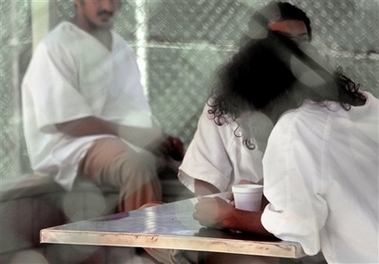
In this June 27, 2006 file photo, reviewed by U.S. military officials, a detainee, name, nationality, and facial identification not permitted, sits with a drink in a styrofoam cup as other detainees sit near him, within the grounds of Camp Delta military-run prison, at the Guantanamo Bay U.S. Naval Base, Cuba. Guantanamo Bay prisoners could soon lose access to their lawyers _ one of their only contacts with the outside world _ because of a new law that eliminates their right to challenge their detention in civilian courts, the lawyers fear. (AP Photo/Brennan Linsley, FILE)

Well, this isn't too surprising. This is from USA Today:

WASHINGTON — The Bush administration is taking a hard line on whether prisoners at the U.S. Navy base at Guantanamo Bay, Cuba, have a right to lawyers to help them file lawsuits challenging their detentions.

In court papers filed during the past two weeks, the Justice Department has insisted that the detainees have "no legal rights," especially the right to counsel.

But the administration says that it will grant defense lawyers access to detainees if the lawyers consent to restrictions that include undergoing body searches and allowing the military to monitor their conversations with their clients.

The legal arguments made by both sides are reminiscent of those they have made for more than two years as they argued whether President Bush can hold "enemy combatants" without charges or access to court for as long as the war on terrorism lasts.

In June, the Supreme Court ruled that the president's war powers are not "a blank check." The court said that a U.S. citizen held in a Navy brig in South Carolina and nearly 600 suspected al-Qaeda and Taliban operatives held in Cuba have a right to contest their detentions.

Justice Department lawyers accuse the detainees' attorneys of stretching the Supreme Court's ruling "way out of proportion." They say the Supreme Court decided only whether federal courts have authority to review challenges by the detainees and did not address whether captives have a right to lawyers.

Attorneys for the detainees accuse the administration of doing an end-run around the Supreme Court. "One would never know that this case had just been to the Supreme Court of the United States, where the government made — and lost — virtually the same arguments it now recycles here," they wrote.

U.S. District Judge Colleen Kollar-Kotelly in Washington plans to hear arguments Monday on the dispute.

So now we know the Bush administration's case for the Gitmo detainees--they have no rights! They have no rights for a trial. They practically have no rights for an attorney, since the Bush administration is willing to grant the detainees an attorney but only on the condition that the administration can review the notes and conversations between the detainee and attorney. This is just sickening:

[The] administration says that it will grant the lawyers access to their clients if they pass and pay for background checks for "secret" security clearances, which the defense lawyers need to review classified documents pertaining to their clients.

Under rules created by the Pentagon, the military will search lawyers before and after they meet with their clients, review any notes that attorneys take and record conversations between lawyers and some of the detainees.

Justice Department lawyers say restrictions are needed to protect national security. But the detainees' lawyers say the policy is an assault on the attorney-client privilege and will "chill" their relationships with the captives.

Talk about a sham here--this is supposed to protect us in the war on terror? This is outright authoritarianism by the Bush White House--lawyers must pass and pay for background checks for security clearances, be subjected to searches (Strip searches perhaps?), and that the state can review any notes and record conversations between the attorneys and their clients? This is not in the interest of fighting terrorism--this is a combination of the Bush administration's CYA for the illegal imprisoning and torturing of terror suspects without any legal recourse, and then trying to impose police-state powers within the United States, after the fact. This has nothing to do with terrorism. If these suspects are guilty of terrorism, then put the terror suspects on a public trial, show us all the evidence of their guilt or innocence--and that includes the so-called secret evidence that the Bush White House refuses to divulge due to "national security," and then have the subjects judged according to the evidence. However, the real reason the Bush administration refuses to even allow these detainees any legal rights, is probably because these detainees were picked up by U.S. forces in the wrong place at the wrong time, or that a number of these suspected terrorists were sold to the U.S. by the Afghan warlords, or Pakistani tribesmen, for cash. And now after four years of captivity, and possibly torture, the Bush administration is worried that the release of these suspects may cause them to turn to terrorism because of their incarceration.

This is another complete failure of the Bush administration's extremism has made a bad situation of fighting against terrorism even worst. It is never-ending.

Friday, October 27, 2006

Cheney's Remarks on Dunking Terrorism Suspects Fuels Debate

This is off The Washington Post:

Vice President Cheney said this week that dunking terrorism suspects in water during questioning was a "no-brainer," prompting complaints from human rights advocates that he was endorsing the use of a controversial technique known as waterboarding on prisoners held by the United States.

In an interview Tuesday with Scott Hennen, a conservative radio show host from Fargo, N.D., Cheney agreed with Hennen's assertion that "a dunk in water" may yield valuable intelligence from terrorism suspects. He also referred to information gleaned from Khalid Sheik Mohammed, the captured architect of the Sept. 11, 2001, attacks, but stopped short of explicitly saying what techniques were used.

"Would you agree a dunk in water is a no-brainer if it can save lives?" Hennen asked.

"Well, it's a no-brainer for me," Cheney said, "but for a while there, I was criticized as being the vice president for torture. We don't torture. That's not what we're involved in."

Uh-oh! Looks like Cheney put his foot in his mouth. Dunking a terror suspect's head in the water is a "no-brainer" for getting valuable intelligence. But that's okay--a dunk in the water is not considered torture by Cheney.

However, Cheney's remark has certainly angered human rights activists. Amnesty International USA's Executive Director Larry Cox issued the following statement:

"What's really a no-brainer is that no U.S. official, much less a Vice President, should champion torture. Vice President Cheney's advocacy of water-boarding sets a new human rights low at a time when human rights is already scraping the bottom of the Bush administration barrel.

The U.S. Department of Defense specifically prohibited water- boarding in its newly issued Army Field Manual. U.S. Senators have stated clearly that water-boarding is unacceptable.

This administration aims at a radical break with our country's proud human rights tradition. The America we believe in does not torture people."

Human Rights Watch issued the following comment:

Cheney’s comments on the legality of waterboarding contradict the views of the U.S. Congress and the U.S. Defense Department, as well as fundamental principles of international law, and could come back to haunt the United States if not corrected by the Bush administration, Human Rights Watch warned.

“If Iran or Syria detained an American, Cheney is saying that it would be perfectly fine for them to hold that American’s head under water until he nearly drowns, if that’s what they think they need to do to save Iranian or Syrian lives,” said Tom Malinowski, Washington advocacy director for Human Rights Watch.

These are the responses from two of the big human rights organizations. Cheney's comments have also been picked up in the blogosphere--Carpetbagger Report, Mahablog, The Democratic Daily, Talking Points Memo, and even The Huffington Post--just to name a few here.

With all this criticism coming up on Cheney's water-boarding comments, the Bush administration needed to go into campaign-spin mode. Continuing with the WaPost article:

Asked about Cheney's comments this morning, President Bush said: "This country doesn't torture. We're not going to torture. We will interrogate people we pick up off the battlefield to determine whether or not they've got information that'd be helpful to protect the country."

At the daily White House briefing, White House spokesman Tony Snow was peppered with questions about what Cheney thought the "dunk in the water" question meant and why, in turn, he considered the "dunk in the water" technique a "no brainer."

"Let me give you the no brainers here," Snow said. " . . . No brainer No. 1 is that we don't torture. No brainer No. 2: We don't break the law -- our own or international law. No brainer No. 3: the vice president doesn't give away questioning techniques. No. 4, the administration does believe in legal questioning techniques of known killers whose questioning can, in fact, be used to save American lives."

Snow said his understanding of Cheney's comments came from a conversation with the vice president's spokeswoman, Lee Anne McBride.

"The vice president says he was talking in general terms about a questioning program that is legal to save American lives," Snow said, "and he was not referring to waterboarding."

You've got to love the spin-mode here. President Bush just keeps denying that the United States does not torture--even after Cheney has said that it is a "no-brainer" for dunking suspects’ heads into water. Tony Snow goes down his own "no-brainer" list: We don't torture. We don't break international law. The vice president doesn't give away questioning techniques--wait a minute, didn't Vice President Cheney say it is a "no-brainer" to dunk suspected terrorists’ heads into water? Isn't that a questioning technique? And finally Snow concludes his "no-brainer" list with it is okay to use "legal" questioning techniques against terrorists if such techniques will save American lives. So does dunking a terrorist's head in the water amount to a legal questioning technique? The vice president believes so--it is a "no-brainer" to him. Of course, the Bush administration has "repeatedly declined to say which techniques they believe are permitted under the new [Anti-terrorism] law and have steadfastly declined to discuss methods used in the past." So even here the Bush administration is contradicting itself, where the President and Press Secretary Snow claims the U.S. doesn't torture, Vice President Cheney considers dunking a terrorist's head into water as a "no-brainer" for questioning and torture techniques, and yet the administration refuses to discuss whatever torture or questioning methods they are currently using, or have used in the past.

But it gets so much better here. Continuing again with the WaPost article:

Snow said his understanding of Cheney's comments came from a conversation with the vice president's spokeswoman, Lee Anne McBride.

"The vice president says he was talking in general terms about a questioning program that is legal to save American lives," Snow said, "and he was not referring to waterboarding."

"What could 'dunk in the water' refer to if not water boarding?" Snow was asked during the briefing.

" . . . I will let you draw your own conclusions," Snow said.

"I'm asking for an explanation about what 'dunk in the water' could mean," the reporter said.

"How about a dunk in the water?" Snow said.

"So 'dunk in the water' means what? -- we have a pool now at Guantanamo, and they go swimming?" the reporter said.

"Are you doing stand up [comedy]?" Snow said, to laughter in the briefing room.

In one sense, you just have to laugh at the absurdity of the Bush administration here. The president denies that the U.S. is torturing. The press secretary asks the reporters what they think torture means, and the vice president flaps his mouth, which gets the administration into trouble in the first place--with less than two weeks to go before the elections. I can't even get angry here because I'm watching a Bush White House that is staffed by clowns. The sad thing is that while these clowns are yucking it up, the waterboarding torture continues on in Gitmo, and other American-controlled prisons in Iraq and possibly Afghanistan.

It is a no-brainer all right.

Wednesday, October 11, 2006

Study Claims Iraq's 'Excess' Death Toll Has Reached 655,000

This is off The Washington Post:

A team of American and Iraqi epidemiologists estimates that 655,000 more people have died in Iraq since coalition forces arrived in March 2003 than would have died if the invasion had not occurred.

The estimate, produced by interviewing residents during a random sampling of households throughout the country, is far higher than ones produced by other groups, including Iraq's government.

It is more than 20 times the estimate of 30,000 civilian deaths that President Bush gave in a speech in December. It is more than 10 times the estimate of roughly 50,000 civilian deaths made by the British-based Iraq Body Count research group.

The surveyors said they found a steady increase in mortality since the invasion, with a steeper rise in the last year that appears to reflect a worsening of violence as reported by the U.S. military, the news media and civilian groups. In the year ending in June, the team calculated Iraq's mortality rate to be roughly four times what it was the year before the war.

Of the total 655,000 estimated "excess deaths," 601,000 resulted from violence and the rest from disease and other causes, according to the study. This is about 500 unexpected violent deaths per day throughout the country.

The survey was done by Iraqi physicians and overseen by epidemiologists at Johns Hopkins University's Bloomberg School of Public Health. The findings are being published online today by the British medical journal the Lancet.

The same group in 2004 published an estimate of roughly 100,000 deaths in the first 18 months after the invasion. That figure was much higher than expected, and was controversial. The new study estimates that about 500,000 more Iraqis, both civilian and military, have died since then -- a finding likely to be equally controversial.

This is certainly an astounding number to consider. The survey can examined here. In reading the survey, the researchers certainly took a lot of pains in eliminating the bias that can creep in and distort the results--the survey was conducted by doctors fluent in both English and Arabic, the surveyors requested death certificates when deaths were reported, and the surveyors certainly asked about in-migration and out-migration of Iraqis. The researchers took the pains to eliminate as much bias as they could from the survey. In fact, the WaPost reports that:

The recent survey got the same estimate for immediate post-invasion deaths as the early survey, which gives the researchers confidence in the methods.

These guys did their job. One little statistic here does stand out. In the original paper, the researchers noted that the number of post-invasion deaths due to violence were at 601,027 (426,369 -– 793,663)

Now let's go to the Bush administration's response to this survey. Here is the CNN story on the survey:

President Bush slammed the report Wednesday during a news conference in the White House Rose Garden. "I don't consider it a credible report. Neither does Gen. (George) Casey," he said, referring to the top ranking U.S. military official in Iraq, "and neither do Iraqi officials."

"The methodology is pretty well discredited," he added.

Last December, Bush said that he estimated about 30,000 people had died since the war began.

When pressed whether he stood by that figure Wednesday, he said, "I stand by the figure a lot of innocent people have lost their life. Six hundred thousand -- whatever they guessed at -- is just not credible."

President Bush still claims that 30,000 people have died since the war began, while also rejecting this latest survey's death rate. And Bush's reason? It's too many deaths. Of course, if we take the researcher's lower numbers of violent deaths at 426,369 as a "credible" number here; it is still over ten times the number of Iraqi deaths that Bush is claiming have occurred since the war began.

Why am I not surprised here?

Monday, September 25, 2006

Negroponte says U.S. not at higher risk

Okay, we’ve seen some pretty wicked stuff coming out over the past week on Iraq and the Bush administration’s Great War on Terror. I’m still trying to read through it and understand it myself. But one thing I’ve noticed so far has been the PR-spin—it is like an amusement park ride, designed to whirl and twirl your head around and around. So I thought it would be fun to take a trip on the newest ride in George Bush’s White House Carnival of Neo-Conservative Fun. We’re talking about the NIE-Spinner.

I'm going to start this fun ride with Sunday’s New York Times story on the NIE estimate that the U.S. invasion of Iraq has increased Islamic radicalism here:

WASHINGTON, Sept. 23 — A stark assessment of terrorism trends by American intelligence agencies has found that the American invasion and occupation of Iraq has helped spawn a new generation of Islamic radicalism and that the overall terrorist threat has grown since the Sept. 11 attacks.

The classified National Intelligence Estimate attributes a more direct role to the Iraq war in fueling radicalism than that presented either in recent White House documents or in a report released Wednesday by the House Intelligence Committee, according to several officials in Washington involved in preparing the assessment or who have read the final document.

The intelligence estimate, completed in April, is the first formal appraisal of global terrorism by United States intelligence agencies since the Iraq war began, and represents a consensus view of the 16 disparate spy services inside government. Titled “Trends in Global Terrorism: Implications for the United States,’’ it asserts that Islamic radicalism, rather than being in retreat, has metastasized and spread across the globe.

An opening section of the report, “Indicators of the Spread of the Global Jihadist Movement,” cites the Iraq war as a reason for the diffusion of jihad ideology.

The report “says that the Iraq war has made the overall terrorism problem worse,” said one American intelligence official.

Sounds pretty bleak and scary--doesn't it? The U.S. is in trouble with creating a whole new network of Islamic radicalism due to the Bush administration’s war in Iraq. Can it get worst? How about this September 21, 2006 Los Angeles Times story about the House Intelligence Committee's report on terrorism and the Iraq war:

WASHINGTON — The House Intelligence Committee warned in a report Wednesday that the terrorist danger facing the United States was "more alarming than the threat that existed prior to Sept. 11, 2001," prompting criticism from Democrats that the Republican-dominated panel was seeking to alarm voters in advance of the midterm elections.

The report was approved by the committee on a party-line vote, with Democrats objecting to its tone and contents in strongly worded minority opinions.

Republicans have sought to focus attention on national security issues, believing voters will prefer the GOP approach. President Bush has made a series of high-profile speeches in recent weeks defending the war in Iraq and repeatedly mentioning Al Qaeda leader Osama Bin Laden.

The House report augments that effort, describing Iraq as the central front in the war on terrorism. Even so, there are portions that appear to undercut White House claims that counter-terrorism efforts over the last five years have made the U.S. significantly safer.

The House report augments that effort, describing Iraq as the central front in the war on terrorism. Even so, there are portions that appear to undercut White House claims that counter-terrorism efforts over the last five years have made the U.S. significantly safer.

Bush and others in the administration have frequently said, for example, that up to half of Al Qaeda's command structure had been captured or killed through aggressive operations by the CIA and other agencies.

But the House report is less sanguine: "Although coalition forces have killed or captured several of Al Qaeda's top leaders, these vacancies have been filled by a new generation of extremists. Most of these new leaders have obscure backgrounds, and the intelligence community lacks knowledge about their particular methods of operating."

The document also warned that Iraq has become a new breeding ground for terrorists who may target other countries. "Fighters who leave Iraq will have acquired first-hand experience in urban warfare," the report said. "Upon returning home, they have the potential to use their knowledge, credibility and popularity to recruit and train younger generations to fight against the United States and our allies."

The committee acknowledged that all of the information in the report was "drawn only from publicly available sources" so that it could be released without concern for classification issues.

Guess what--we're losing the Great War on Terrorism! We’re in really deep doo-doo here--why, even Donald Rumsfeld is not safe, with three top American military leaders calling for his resignation in a Democratic Party congressional committee hearing, due to his involvement in the disaster of Iraq. The terrorists are coming to attack and kill us--these intelligence reports even say so! We're doomed!

But don't fear--all is not lost! For the chief intelligence czar John Negroponte is here to save the day! This is also from The Washington Post:

The conclusion of U.S. intelligence analysts that the Iraq war has increased the threat from terrorism is only "a fraction of judgments" in a newly disclosed National Intelligence Estimate, Director of National Intelligence John D. Negroponte said yesterday.

"What we have said, time and again, is that while there is much that remains to be done in the war on terror, we have achieved some notable successes against the global jihadist threat," Negroponte said in a statement. "The conclusions of the intelligence community are designed to be comprehensive, and viewing them through the narrow prism of a fraction of judgments distorts the broad framework they create."

This NIE conclusion represents only "a fraction of the judgments" in the full NIE report? So John, if you claim that the conclusions are only a fraction of the judgments in this NIE report, then why not publish the entire report so we can see the full conclusions and the majority of the judgments that say we're winning the GWOT, and in Iraq? Show everything so we can make the decisions about the Bush administration’s GWOT, and Iraq, ourselves. And by the way John, could you also please name some of those "successes against the global jihadist threat?

Negroponte-spin not working! Must find new Neocon hero—two neocon heros! How about Republican Spin-Machine is here to save the day! I found this off of another Washington Post story titled, Democrats Focus on Terrorism Report in Attacks on Bush:

Frances Fragos Townsend, the top White House adviser on terrorism, said one paragraph in nine pages of "key judgments" from the intelligence community discusses how "the war in Iraq is being used by extremists to spread the global extremist message," but added, "It does not say it has made us less safe." The "one thing that would make us less safe" is an immediate withdrawal of U.S. troops from Iraq, she added.

Senate Majority Whip Mitch McConnell (R-Ky.) noted that there have been no attacks on the United States since Sept. 11, 2001, and he described the new reports as "selective leaks put out within five or six weeks of the election designed to help the Democrats get control of the Congress."

So, the Democrats are now considered "extremists" by White House advisor Frances Fragos Townsend, because they are using the NIE report to criticize the Bush administration's war in Iraq, thus spreading "the global extremist message" that is making America less safe. So Ms. Townsend, if you're connecting the Democrats to extremists, spreading a "global extremist message," does that also mean you're connecting the Democrats to the terrorists? Are the Democrats aiding the terrorists? Is that what you're saying?

But Senate Majority Whip Mitch McConnell makes an even more outragious statement--There have been no attacks on the United States since September 11th. Um, Mitch--did it ever occur to you that the al Qaeda terrorists have not attacked the U.S. mainland because of the logistical difficulties in setting up and carrying out such attacks in this post-9/11 world? Besides, why should al Qaeda even attack the U.S. mainland again--not when they can head over to Iraq and attack the U.S. occupation troops, with shorter supply lines and better communications between al Qaeda terror cells?

Must bring out big PR-spin-meister guns! Must go to the prima donna White House press secretary Tony Snow, and hear what he had to say about the NIE report:

Spokesman Tony Snow sought to challenge news reports on Sunday about the latest National Intelligence Estimate on Iraq and terrorism, which represents the comprehensive consensus findings of the 16 US intelligence agencies.

[The NIE report] "notes that should jihadists be perceived to have failed in Iraq, fewer will be inspired to carry on the fight," the spokesman said as US
President George W. Bush traveled here for a political fundraiser.

Bush has been saying that the war made Americans safer as he campaigns ahead of November 7 legislative elections, in which the unpopular war in Iraq may cost his Republican party control of one or both houses of the US Congress.

The Washington Post said the report described the Iraq conflict as the primary recruiting vehicle for violent Islamic extremists.

While the US has seriously damaged Al-Qaeda and disrupted its ability to carry out major operations since the September 11, 2001, attacks on New York and Washington, it noted, radical Islamic networks have spread and decentralized.

"One thing that the reports do not say is that war in Iraq has made terrorism worse," said Snow, who also insisted that the new reports "contain nothing that the president hasn't said."

Talk about parsing the language here. The NIE report doesn't say that the war in Iraq has made terrorism worse--Tony Snow is now parsing the language to say that Bush's war in Iraq has forced the terrorists to fight in Iraq, rather than here in the US--thus claiming that the Bush administration has protected the U.S. homeland since there have been no terrorist attacks on the U.S. since September 11th. So in fact according to Tony Snow's view, the war in Iraq has actually made America safer since we're fighting those al Qaeda terrorists in Iraq. Didn’t Negroponte just criticized Democratic opponents for parsing the language of the NIE report by saying such opponents are taking only "a fraction of judgments” in the report to criticize the Bush administration? Didn’t both Francess Townsend and Mitch McConnell parse the NIE report—Townsend saying that Democratic Party criticisms are also contributing to the rise of “the global extremist message—thus linking Democratic criticisms of the Bush administration with the rise of Islamic radicalism? Didn’t Mitch McConnell parse the NIE report by claiming the Bush administration protected the U.S. from terror attacks because there have been no al Qaeda terror attacks since 9/11? Why am I seeing twirly-swirly circles all around me?

Look at me--I'm spinning! Weeeeeeee!