Wednesday, November 16, 2005

U.S. Has Detained 83,000 in War on Terror

I really don't have a commentary on this post. It is just too mind-numbing for me. This is from Yahoo News:

WASHINGTON - The United States has detained more than 83,000 foreigners in the four years of the war on terror, enough to nearly fill the NFL's largest stadium. The administration defends the practice of holding detainees in prisons from Afghanistan to Guantanamo Bay as a critical tool to stop the insurgency in Iraq, maintain stability in Afghanistan and get known and suspected terrorists off the streets.

Roughly 14,500 detainees remain in U.S. custody, primarily in Iraq.

The number has steadily grown since the first CIA paramilitary officers touched down in Afghanistan in the fall of 2001, setting up more than 20 facilities including the "Salt Pit," an abandoned factory outside Kabul used for CIA detention and interrogation.

In Iraq, the number in military custody hit a peak on Nov. 1, according to military figures. Nearly 13,900 suspects were in U.S. custody there that day — partly because U.S. offensives in western Iraq put pressure on insurgents before the October constitutional referendum and December parliamentary elections.

The detentions and interrogations have brought complaints from Congress and human-rights groups about how the detainees — often Arab and male — are treated.

International law and treaty obligations forbid torture and inhumane treatment. Classified memos have given the government ways to extract intelligence from detainees "consistent with the law," administration officials often say.

On Capitol Hill, Sen. John McCain, R-Ariz., is leading a campaign to ban cruel, inhuman or degrading treatment of prisoners in U.S. custody. The administration says the legislation could tie the president's hands. Vice President Dick Cheney has pressed lawmakers to exempt the CIA.

"There's an enemy that lurks and plots and plans and wants to hurt America again. And so you bet we will aggressively pursue them. But we will do so under the law," President Bush said last week.

So, Mr. President--are you saying that those 83,000 we've detained are all enemy terrorists, who should be locked up in jail and have the key thrown away? Continuing on:

Some 82,400 people have been detained by the military alone in Afghanistan and Iraq, according to figures from officials in Baghdad and Washington. Many are freed shortly after initial questioning.

To put that in context, the capacity of the Washington Redskins' FedEx Field, the NFL's largest, is 91,704. The second largest, Giants Stadium, holds 80,242.

An additional 700 detainees were sent to Guantanamo Bay, Cuba. Just under 500 remain there now.

In Iraq, the Defense Department says 5,569 detainees have been held for more than six months, and 3,801 have been held more than a year. Some 229 have been locked up for more than two years.

It is mind-boggling. That's all I can say. Mind-boggling.

Document Says Oil Chiefs Met With Cheney Task Force

This is from the Washington Post:

A White House document shows that executives from big oil companies met with Vice President Cheney's energy task force in 2001 -- something long suspected by environmentalists but denied as recently as last week by industry officials testifying before Congress.

The document, obtained this week by The Washington Post, shows that officials from Exxon Mobil Corp., Conoco (before its merger with Phillips), Shell Oil Co. and BP America Inc. met in the White House complex with the Cheney aides who were developing a national energy policy, parts of which became law and parts of which are still being debated.

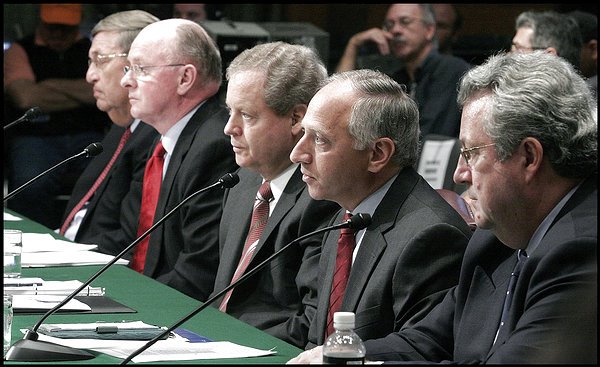
In a joint hearing last week of the Senate Energy and Commerce committees, the chief executives of Exxon Mobil Corp., Chevron Corp. and ConocoPhillips said their firms did not participate in the 2001 task force. The president of Shell Oil said his company did not participate "to my knowledge," and the chief of BP America Inc. said he did not know.


(Testifying at a Senate hearing last week were, from left, Lee R. Raymond of Exxon Mobil, David J. O'Reilly of Chevron, James J. Mulva of ConocoPhillips, Ross Pillari of BP America and John Hofmeister of Shell Oil. From Chip Somodevilla at Getty Images.)


Chevron was not named in the White House document, but the Government Accountability Office has found that Chevron was one of several companies that "gave detailed energy policy recommendations" to the task force. In addition, Cheney had a separate meeting with John Browne, BP's chief executive, according to a person familiar with the task force's work; that meeting is not noted in the document.

No wonder Commerce Chairman Ted Stevens (R-Alaska) refused to swear in the oil executives as the Democrats demanded.

This was a complete sham and cover-up by the Republicans. We knew that Cheney's energy task force was talking to officials from the big oil and energy companies, while at the same time Cheney was refusing to even meet with environmentalists. Why else would Cheney keep the records of who the energy task force met with classified? Now with the American public starting to get worried about increasing energy costs and increasing gas prices, while at the same time big oil companies are making record huge profits, is it no wonder that rumors of big oil companies are price gouging the American consumers, are starting to resurface? Finally, with the American public starting to believe the Democrats can govern this country better than the Republicans, is it no wonder that the Republicans in Congress are scared that they will be trounced in the 2006 midterm elections? Also remember that President Bush's poll numbers have also been dropping steadily.

So what do the Senate Republicans do? They announce these Senate hearings to supposedly rake the Big Oil execs over the coals for their excessive profits and their supposedly price gouging practices. Only the Senate Republicans know they can't force these executives to testify under oath, for questions will certainly come up regarding Cheney's energy task force meetings. Big Oil was certainly involved with the energy task force--it's no big secret, considering the task force recommended tax breaks and subsidized goodies for Big Oil and energy companies. So Ted Stevens quashes the Democrats demands for the executives to testify under oath, and Big Oil execs start lying through their teeth. But there's just one small problem. Some records have surfaced which not only show Big Oil lying to Congress, but also makes Stevens look like a complete fool who's in the pocket of Big Oil (Of which Stevens' probably is, coming from Alaska which has extensive oil interests). This is another example of the complete and utter corruption that has taken over the Republican Party, who will protect whatever corporate or business interests the can--regardless of how far they will destroy this country.

It is time for the Democrats to start looking into the ethics of Ted Stevens, and demand an investigation into Big Oil's connections with the Republicans. And the only way to do that is to win the Senate in 2006.

Tuesday, November 15, 2005

Disturbing Story about Bush's State of Mind


This story is actually the mixing of four different sources. Americablog starts it off by reporting that President Bush is in the midst of a meltdown. The source of Americablog's story is the extremely conservative Washington Times Insight story titled Bush rarely speaks to father, 'family is split.' Here is the opening paragraph for the Insight story:


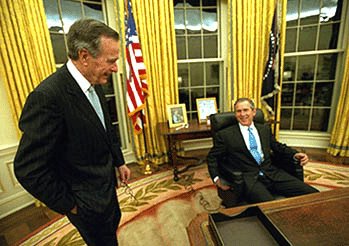
President Bush feels betrayed by several of his most senior aides and advisors and has severely restricted access to the Oval Office, administration sources say. The president's reclusiveness in the face of relentless public scrutiny of the U.S.-led war in Iraq and White House leaks regarding CIA operative Valerie Plame has become so extreme that Mr. Bush has also reduced contact with his father, former President George H.W. Bush, administration sources said on the condition of anonymity.

The rest of the Insight story is subscriber-based, meaning I cannot access it without paying money to the Washington Times. However the Drudge Report includes more little details regarding the Times story. Here's what the Drudge Report says:

President Bush feels betrayed by several of his most senior aides and advisors and has severely restricted access to the Oval Office, INSIGHT magazine claims in a new report.

The president's reclusiveness in the face of relentless public scrutiny of the U.S.-led war in Iraq and White House leaks regarding CIA operative Valerie Plame has become so extreme that Mr. Bush has also reduced contact with his father, former President George H.W. Bush, administration sources said on the condition of anonymity.

"The atmosphere in the Oval Office has become unbearable," a source said. "Even the family is split."

INSIGHT: Sources close to the White House say that Mr. Bush has become isolated and feels betrayed by key officials in the wake of plunging domestic support, the continued insurgency in Iraq and the CIA-leak investigation that has resulted in the indictment and resignation of Lewis "Scooter" Libby, Vice President Dick Cheney's former chief of staff.

The sources said Mr. Bush maintains daily contact with only four people: first lady Laura Bush, his mother, Barbara Bush, Secretary of State Condoleezza Rice and Undersecretary of State Karen Hughes. The sources also say that Mr. Bush has stopped talking with his father, except on family occasions. [Italics are mine]

Now the Daily Kos. The Daily Kos also reports, through the Washington Times article, that Bush is only maintaining contact with Laura Bush, Barbara Bush, Rice, and Hughes. But Kos adds another interesting little piece of information regarding the split between George Bush and his father. This is another part of the subscriber article from the Washington Times, as cited by the Daily Kos:

For the president, what triggered the break with his father was the interview given to the New Yorker magazine in October by Brent Scowcroft, who served as national security advisor in the first Bush presidency. In the interview, Mr. Scowcroft criticized the administration's handling of Iraq. The sources said the president is convinced that Mr. Scowcroft consulted with Mr. Bush's father prior to delivering the devastating critique of the president's Iraq policy. [...]

Relations between Mr. Bush and his chief political adviser, Karl Rove, had also become tense in the build-up to the indictment of Mr. Libby. This is due to the fact the president believed his chief aide when Mr. Rove said that he had nothing to do with the leak of Mrs. Plame's identity. The prospect that Mr. Libby will turn state evidence in the Plame case is even more alarming for the White House.

Now I'm not sure what to make of all this. First, the Washington Times is owned by the Reverend Sun Myung Moon and his Moonies. It is an extremely conservative paper--sometimes considered the mouthpiece of the Republican Party. So I wouldn't consider it as reputable as other mainstream press organizations. But then there's these anonymous administration sources for this Times story. Since the Washington Times is a conservative paper, its reporters could certainly have cultivated some serious connections inside the White House, considering the Times may have written a number of stories favorable to the White House. These administration sources could certainly have said something to the Times reporters regarding the environment in the Oval Office. And any journalist who can get this type of information from several administration sources knows he/she has a scoop on their hands. So there could be a grain of truth to these Times stories. Or the Times reporters are simply lying, making this stuff up, or insulating President Bush from possible impeachment or indictment by making him seem like he's losing it. I cannot say.

But there's another interesting aspect to this story. And that's the information inside the story itself. If the Times article is accurate, then President Bush has insulated himself even further by listening to the advice of four women--his wife, his mother, and twconfidantsnfidents of Rice and Huges. As president, you need advisors with the breadth and depth of knowledge and experience on a wide-range of policy issues. And sometimes, you need dissenting views on policy issues to foster and encourage debate within your staff to think outside the box and come up with unique alternatives. President Bush has never really had that type of staff--he's always been surrounded by "yes men," who've developed their own policy issues around Bush's broad ideals, then have slickly marketed them to the president. Look at how the PNAC neocons have gotten Bush to adopt his policy, since Bush had always felt his father was wrong for stopping short the First Gulf War. So to have these four women giving President Bush advice regarding complex foreign, defense, and domestic policy issues, while Bush is shutting out the advice of more experience policy analysts (Career analysts and not the neocons or Bush-appointed cronies), is rather disturbing.

The second aspect of this Times story is both Karl Rove, the Bush's supposed falling out with his father. According to the Times, relations between Rove and Bush have become tense when President Bush believed Rove's claim that he had nothing to do with the Valerie Plame leak. And the investigation may still point towards Rove. If this is true, then Rove lied to President Bush. The problem here is that Bush can't really fire Rove--Bush needs Rove more than Rove needs Bush. Karl Rove is the chief political strategist and brains behind the Bush White House. With Karl Rove gone from the White House, the Bush administration becomes even more lost, more aimless, and more helpless in trying to sort out these complex issues. I'm not saying Karl Rove is good or bad for the Bush White House. I'm saying that Karl Rove is one of two of the most powerful men in the Bush White House (the other being VP Dick Cheney). With Rove gone, the Bush White House would become even more disjointed, confused and contradictory in its political strategy and policy issues.

Now the Bush falling out with his father, George H.W. Bush. The Times article said that George Bush is convinced that Bush Senior gave Brent Scowcroft advise for Scowcroft's critique of current President Bush's Iraq policy in the October issue of New Yorker magazine. Never mind the fact that Scowcroft was the national security advisor for Bush Senior's administration, and was certainly closely involved, with Bush Senior, in the First Gulf War. So the president is angry at both Scowcroft and his father--Scowcroft for criticising Bush's current Iraq strategy, and Bush Senior for allegidly advising Scowcroft on the critique. If anything, these are two people the president needs in his inner circle of advisors--if he is to find a way out of Iraq. The neocons are running the "stay the course" PR message, while happily turning the U.S. into an imperial power in the Middle East, with disasterous results. And the only close advisors that President Bush is listening to are four women, who have almost no experience regarding this issue? But this brings up another problem with President Bush, and that is his extreme stubborness and hubris. Bush has never experienced a major failure in his life. He's always had Daddy Bush to bail him out, whenever he needed help. Regarding Iraq, George Bush has always felt that his father was wrong for not marching into Baghdad and taking out Saddam. So the Iraq invasion was George Bush's way to right the mistakes of his father's administration. The problem is that this second Iraq invasion was a terrible mistake on the son's part, and the son will refuse to admit it to the father--or ask for the father's help in correcting this mistake.

So what does this mean? If the Times story is true, then Bush is living in a bubble--further disconnected from reality than we could even realize. The pressures are certainly not going to abate. Iraq is still deteriorating. Bush's poll numbers are still falling--and we've got three more years to go of his presidency. I'm not sure how long these four women of Bush's life can provide policy advise as this country descends into a Twilight Zone of madness. What would happen if this country faces another crisis, similar to 9/11 or Katrina? I'm not sure what's going to happen in the next three years, but it doesn't look good.

Senate demands accountability on war


This is from CNN.Com:

WASHINGTON (CNN) -- The Senate demanded regular reports on the progress of the war in Iraq on Tuesday but rejected a Democratic plan to require the Bush administration to lay out a timeline for a U.S. withdrawal.

Senators voted 79-19 to add language to a $491 billion Pentagon spending bill that declares 2006 to be "a period of significant transition" for Iraq and calls on the Bush administration "to explain to Congress and the American people its strategy for the successful completion of the mission in Iraq."

The measure was drafted largely by Democrats, but GOP leaders removed language that would have called for a flexible timetable for a possible American pullout from Iraq.

But because its stated purpose was "to clarify and recommend changes" to U.S. policy in Iraq, Senate Democratic leader Harry Reid called its adoption a vote of "no confidence" in the administration and said "staying the course will not do."

"The administration's strategy is aimless, and sadly, it's rudderless," said Reid, a Nevada Democrat. "[The vote is] a victory for our troops and the American people."

So the Senate Republicans have basically co-opted the Democratic plan for President Bush to layout a U.S. withdrawal timetable, without the timetable of course, and instead demand that Bush provide "progress reports" to the Senate. The Republicans are getting a little scared about where Iraq--and President Bush's poll numbers--are heading. So now the Republicans are scrambling to show they are trying to do something, so they try to maintain their jobs in 2006.

Of course, this is all for show to the voters. It is another delaying tactic by the Republicans in the Senate to protect both the Bush White House, and the Republican Party from the criticisms it has received regarding Iraq. This is also a PR stunt to deceive the voters by implying that the Senate Republicans are taking a harsher stand against the Bush White House in resolving Iraq. Nothing will come from this. There will be no "period of significant transition," nor will the Bush administration explain its mission in Iraq. In fact, consider what Sen. John Warner, the chairman of the Armed Services Committee, said about this measure:

Warner, a Virginia Republican, said its message was largely aimed at Iraq's fledgling government, which he said needs "to take a stronger, take-charge action" once a permanent parliament is elected in December.

"The coalition forces, most particularly the United States and Great Britain, have done their job," he said. "Now we expect in return that they take charge of their nation and run it and form a democracy and prevent any vestige of a civil war from taking place."

So this measure wasn't even aimed at the Bush administration, but rather at the US-occupied country of Iraq, and its government. The Republican-controlled Senate is demanding that Iraq's government must resolve this insurgency--even though the U.S. initiated the insurgency by invading and occupying Iraq in the first place.

It gets better though. Remember those so-called "progress reports" that the Senate demanded that the Bush administration present to them? Well, here's the standard White House PR response:

Defense Secretary Donald Rumsfeld said the Pentagon already sends numerous reports to Congress about the progress of the war but that the lawmakers' push for more information was understandable.


He said the withdrawal of U.S. troops will depend on when Iraqi forces can take their place, "and already some responsibilities are being assumed by the Iraqi security forces."

"We must be careful not to give terrorists the false hope that if they can simply hold out long enough that they can outlast us," he said.

What information? What progress reports? The only progress reports that the Bush administration has presented was to "stay the course," and "we'll succeed when we've completed our mission." Now Rummy is saying we can't give terrorists false hopes so they can outlast us? What nonsense is that? Of course, what Rummy doesn't say is that the lawmaker's push for more information from the Pentagon is denied, since such information is also classified.

But it gets better. Here's what else Rummy said:

Rumsfeld waded into the dispute Tuesday, citing Clinton administration statements that Iraqi dictator Saddam Hussein, ousted in 2003, would have rebuilt his weapons programs if left alone.

He said President Bush launched the war in Iraq based on "the same information that President Clinton and the previous administration had."

"It's the same information members of the House and Senate had. It's the same information that the other intelligence services had," he said.

"People who are willing to risk their lives need to know the truth," Rumsfeld said. "They need to understand that they are there based on decisions that were made in good faith, by responsible people, and that this world is going to be a lot better off with Saddam Hussein gone and with that country on a path toward democracy."

Got to bring up Bill Clinton again. Bill Clinton had the same intelligence information that Bush had, and the same intelligence information that Congress had. There's only one difference between Bill Clinton and George Bush--Bill Clinton did not invade Iraq. George Bush did. Of course, Rummy also finishes with the White House PR statement of "the world is better off with Saddam gone," climax.

The Bush administration is still living in fantasyland.

Cheney Heckled by Anti-War Protesters


This is from Yahoo News:

KNOXVILLE, Tenn. - Vice President Dick Cheney was heckled by peace protesters Tuesday as he spoke at the groundbreaking for a public policy center honoring former Senate Majority Leader Howard Baker.

During Cheney's remarks, about a half-dozen people protesting the war in Iraq yelled, "War, what is it good for?" and held up a large banner saying, "Peace Now."

Cheney continued speaking and didn't acknowledge the protesters, who were escorted from the ceremony inside the University of Tennessee's basketball arena.

About 50 protesters, most of them appearing to be college age, demonstrated outside. Several carried signs, including one that read "Honor Baker, Impeach Cheney."


Cheney during the event lauded Baker, a Republican who was President Reagan's chief of staff and ambassador to Japan.

"It's good to know that far into the future people will come to this place and learn of Howard's career and his deep belief in the nobility of public service," Cheney said.

About 400 people attended the ceremony, which coincided with Baker's 80th birthday.

I'm surprised that Cheney didn't address the protesters with his famous comment of $%&# You!

Poll: Bush approval mark at all-time low

This is from CNN.Com:

(CNN) -- Beset with an unpopular war and an American public increasingly less trusting, President Bush faces the lowest approval rating of his presidency, according to a national poll released Monday.

Bush also received his all-time worst marks in three other categories in the CNN/USA Today/Gallup poll. The categories were terrorism, Bush's trustworthiness and whether the Iraq war was worthwhile.

Bush's 37 percent overall approval rating was two percentage points below his ranking in an October survey. Both polls had a sampling error of plus or minus three percentage points.

We've got another poll showing Bush's sinking job performance numbers. But that's not the real kicker in this news story. Here's the White House response to the low approval ratings:

The White House has said it doesn't pay attention to poll numbers and the figures do not affect policy.

"We have a proud record of accomplishment and a positive agenda for the future," White House spokesman Scott McClellan told reporters Wednesday.

"We look forward to continuing to talk about it. I mean, you can get caught up in polls; we don't. Polls are snapshots in time."

How can Scotty McClellan stand up in front of reporters and say this sort of gibberish every day, when no one believes him? We don't pay attention to poll numbers. We have a proud record of accomplishments--polls are snapshots in time! Well those snapshots in time have been showing a continued decreasing support of Bush's job performance by the American public. There's a trend going on. And that trend is the American public thinks that President Bush is taking the country down the wrong track, and is ignoring all the warning signs.

So what do we have? We've got Scotty regurgitating the same White House BS--day in and day out. And nobody believes him. I'm waiting for the day when Scotty's press conferences will be televised live--with a laugh track.

Microsoft to remove Sony malware from PCs

I found this off MSNBC website:

AMSTERDAM - Microsoft said it would remove controversial copy-protection software that CDs from music publisher Sony BMG install on personal computers, deeming it a security risk to PCs running on Windows.

The XCP program, developed by First4Internet in Britain and used on music CDs by Sony BMG to restrict copying and sharing, has generated concern amongst computer users, because it acts like virus software and hides deep inside a computer where it leaves the backdoor open for other viruses.

"We have analyzed this software and have determined that in order to help protect our customers, we will add a detection and removal signature for the rootkit component of the XCP software to the Windows AntiSpyware beta, which is currently used by millions of users," Jason Garms, group program manager of the Anti-Malware Technology Team, said on Microsoft's Technet blog.

Sony BMG last week provided a patch to make the program more visible after the discovery that hackers had taken advantage of the weakness to install viruses on PCs.

Outcry
Responding to public outcry, the music publishing venture of Japanese electronics conglomerate Sony Corp. and Germany's Bertelsmann AG also said on Friday it would temporarily suspend the manufacture of music CDs containing XCP technology.

Asked to comment, the music publisher referred to its Friday statement. Last week, Sony BMG was targeted in a class action lawsuit complaining it had not disclosed the true nature of its copy-protection software.

Sony BMG's patch does not remove the program, which installs itself on a Windows-operated personal computer when consumers want to play certain Sony BMG music CDs. According to programmers it still leaves a security hole.

That was after the U.S. government had weighed in. A representative of the U.S. government last week warned entertainment publishers against using CD and DVD copy protection software that hides inside computers.

"It's very important to remember that it's your intellectual property; it's not your computer. And in the pursuit of protection of intellectual property, it's important not to defeat or undermine the security measures that people need to adopt in these days," said Stewart Baker, the assistant secretary the Department of Homeland Security, at a conference.

The Sony copy-protection software does not install itself on Macintosh computers or ordinary CD and DVD players.


I have a perfect response to this malicious abuse of corporate power--DON'T BUY SONY CDs or any products! It is almost getting to the point where you're going to need two or three computers in the house--one to surf the internet (and fight malicious spyware, adware, and spam), one to rip CDs into MP3s (that's not connected to the internet), and a third computer just to do whatever critical work you may have to do. It is one thing to be fighting the constant barrage of Viagra, cheap home mortgage, and see-me-on-my-webcam ads, but now corporations are starting to place their own malicious software on our home computers.

I'll admit that companies have a right to protect their intellectual property. But I don't believe that Sony's copyright protection extends to the point where they can place programs on my computer--without my knowledge-to monitor what my computer usage. What is worst, is that I wonder how many other music companies are also developing software similar to Sony's--Atlantic, Time Warner, Virgin, Columbia? What's on their CDs?

I guess the only way to fight this is to not purchase music CDs from Sony or any other big entertainment company at all.

Monday, November 14, 2005

Santorum: Don't put intelligent design in classroom

I found this little story off of Shakespeare's Sister's website. It is a story from the Beaver County Times Online:

BEAVER FALLS - U.S. Sen. Rick Santorum said Saturday that he doesn't believe that intelligent design belongs in the science classroom.

Santorum's comments to The Times are a shift from his position of several years ago, when he wrote in a Washington Times editorial that intelligent design is a "legitimate scientific theory that should be taught in the classroom."

But on Saturday, the Republican said that, "Science leads you where it leads you."

Santorum was in Beaver Falls to present Geneva College President Kenneth A. Smith with a $1.345 million check from federal funds for renovations that include the straightening and relocation of Route 18 through campus.

Santorum's comments about intelligent design come at a time when the belief that the universe is so complex that it must have been created by a higher power, an alternative to the theory of evolution, has come under fire on several fronts.

A federal trial just wrapped up in which eight families sued Dover Area School District in eastern Pennsylvania. The district's school board members tried to introduce teaching intelligent design into the classroom, but the families said the policy violated the constitutional separation of church and state.

Talk about ducking for political cover. Santorum is the number three man in the Republican Part, and is one of the more conservative members of the Senate. He has been one of the more loyal partisans for the Bush White House. And because of this loyalty, and his extreme conservative views, Santorum has been watching his poll numbers slip during his re-election bid. He is out of touch with the mainstream voters. So what's an embattled senator suppose to do? Well, let's just completely change our opinion of intelligent design, and hope the voters will forgive and forget.

Let's hope the voters see through this charade.

Sunday, November 13, 2005

President Jeb Bush? Jeb Bush leaves open White House bid

I found this off Yahoo News:

BERLIN (Reuters) - Florida Gov. Jeb Bush, the brother of U.S. President George W. Bush, ruled out running for president in 2008 but left open the possibility of a subsequent bid in an interview with a German magazine published on Sunday.

Jeb Bush, who is scheduled to visit Germany this week, told Focus weekly he had not thought much about running for the office held by his father and older brother except to rule out the next election at the end of George W. Bush's second term.

"You should never say never. But for the 2008 election, my answer is definitely no," he said, in comments translated into German by the magazine.

Asked whether his answer meant a later challenge was possible, he said: "Let's say there's a vague chance."

Bush, 52, said he spoke frequently with his brother and visited the White House whenever he was in Washington but he said the two mainly discussed family matters or sport.


Let's face it--Jeb Bush is a smart politician. He knows there is no way he can possibly run for the White House in 2008, considering how politically toxic brother George is right now as he sits in the Oval Office. The country is in a sour mood, with poll numbers for Bush dropping rapidly, serious problems and scandals being exposed which involves the White House, and much of the public now believing the country is on the wrong track. Jeb Bush can't distance himself from his brother. Interestingly enough, had George Bush not gone into Iraq--or had the war and occupation been a success to where we were massively pulling our troops out now--Bush's popularity may have gone up above 50 percent. And if George Bush's popularity was above 50-60 percent, you can bet Jeb Bush would be organizing for his own run for the White House.

But Iraq has not been a success, and George's popularity is hovering in the upper 30s. With Jeb Bush personally connected as family to George, the country will not accept the transfer of the White House from an older brother's two disastrous terms to a younger brother. So Jeb will sit out in 2008, and let someone else in either the Democratic or Republican Party take over. And if Iraq continues to go south until 2012, you can bet Jeb Bush will make a run for the 2012 elections, blaming the unnamed current president for the disastrous war in Iraq, and possibly proclaiming his own plan for winning the war. That's if Iraq continues to be a major issue. Either way, Jeb Bush will try to run and hope that the country will forget his brother George's two terms.

Can you say Jeb Bush verses Hillary Clinton?

Friday, November 11, 2005

Bush Forcefully Attacks Critics of His Strategy in Iraq

This is from the New York Times:

President Bush lashed out today at critics of his Iraq policy, accusing them of trying to rewrite history about the decision to go to war and saying their criticism is undercutting American forces in battle.

"While it's perfectly legitimate to criticize my decisions or the conduct of the war, it is deeply irresponsible to rewrite the history of how that war began," the president said in a Veterans Day speech in Pennsylvania.

It is deeply irresponsible to rewrite the history of how the war began? Excuse me? If I recall, the Bush White House was constantly rewriting the history regarding their reasons of why we had to go to war in Iraq. First, Iraq had WMDs--or was trying to purchase uranium yellowcake from Niger to make a nuclear weapon. The evidence for yellowcake purchases from Niger turned out to be forgeries. Then it was Iraq was a serious threat to the United States, with smoking guns turning into mushroom clouds. The U.N. inspectors never found any smoking guns. Then the reason was Iraq was a state-sponsor of terrorism, and Iraq was helping al Qaida. Well, no evidence surfaced regarding that connection. Then it was Saddam was an evil person--comparable to Adolph Hitler, and the U.S. was like the victorious allies--where Iraqi women and children would flow flowers down at the soldier's feet. Just about every reason that President Bush presented for the U.S. to invade Iraq has been debunked. And yet, the administration continues to present their own re-written version of history. Continuing on:

Today's remarks by the president, which painted his critics as hypocrites, drew quick and angry responses from Democrats, and quickly led to a back-and-forth with Republicans about who was exploiting Veterans Day by using it as a forum to voice their views on Iraq. The president's speech is part of a new strategy by the administration that will play out in the next few weeks in other presidential speeches and remarks by other leading Republicans, top senior administration officials said.

The president spoke at the Tobyhanna Army Depot near Wilkes-Barre. He talked not only about why Americans are at war - "the terrorists are as brutal an enemy as we've ever faced, unconstrained by any notion of our common humanity or by the rules of warfare" - something he has mentioned in almost every speech, but turned on his critics more directly than he usually does.

What is so funny is that President Bush's name-calling of the Democrats "hypocrites" is the only argument he has for defending this war. His credibility and trustworthiness has been shot, a top White House aid is on trial for lying, and serious allegations regarding Valerie Plame's outing still taint Vice President Cheney and ubber-strategist Karl Rove. Bush no longer has a reasonable argument left as to why we should be in Iraq. And if you can't use reason to win the debate, you end up reverting to name calling. But it gets better. Bush continues on, saying:

"The stakes in the global war on terror are too high, and the national interest is too important for politicians to throw out false charges," he said. "These baseless attacks send the wrong signal to our troops and to an enemy that is questioning America's will."


That's the old, "You're either with us or against us. And if you're against us, then you're with the terrorists," attack. Of course, there's the added argument of, "If you're not supporting the war, then you're not supporting the troops." I don't know how many times I've heard these baseless points brought up again and again through the Republican Echo-Machine. And yet they still keep coming back to them. But the best is yet to come:

Before going to war, Mr. Bush said, Democrats and Republicans alike were privy to the same intelligence that indicated former Iraqi leader Saddam Hussein had weapons of mass destruction.

"Some Democrats and antiwar critics are now claiming we manipulated the intelligence and misled the American people about why we went to war," he said. "These critics are fully aware that a bipartisan Senate investigation found no evidence of political pressure to change the intelligence community's judgments related to Iraq's weapons programs. They also know that intelligence agencies from around the world agreed with our assessment of Saddam Hussein."

A bipartisan Senate investigation found no evidence of political pressure. The simple reason they didn't find any evidence of political pressure was that Intelligence Committee Chair Sen. Pat Roberts, R-Kan, drug his feet at initiating any investigation of intelligence connections with the White House. Roberts has been delaying that investigation--even though he has promised to look into the White House use of intelligence as a marketing plan for the war. It was Roberts' feet dragging and delaying tactics that caused Senate Minority Leader Harry Reid to invoke Rule 21, and force a closed session debate in the Senate two weeks ago. Finally, while accurate intelligence assessments of Saddam's WMD program was certainly hard to come by for both the Bush and Clinton administrations, it was George Bush, and the neocon advisors who worshipped PNAC, that decided the U.S. should invade Iraq. While Bill Clinton may have gotten the same intelligence assessments, Clinton determined that, while Iraq could pose a threat to the Middle East, it was not a serious threat to the United States. Bill Clinton did not send us into war with Iraq.

George Bush did.

Pat Robertson Warns Pa. Town of Disaster


I've seen this on the news and blogsites, but I haven't really commented on it--at least not yet. This is from Yahoo News:

VIRGINIA BEACH, Va. - Religious broadcaster Pat Robertson warned residents of a rural Pennsylvania town Thursday that disaster may strike there because they "voted God out of your city" by ousting school board members who favored teaching intelligent design.

All eight Dover, Pa., school board members up for re-election were defeated Tuesday after trying to introduce "intelligent design" — the belief that the universe is so complex that it must have been created by a higher power — as an alternative to the theory of evolution.

"I'd like to say to the good citizens of Dover: If there is a disaster in your area, don't turn to God. You just rejected him from your city," Robertson said on the Christian Broadcasting Network's "700 Club."

Eight families had sued the district, claiming the policy violates the constitutional separation of church and state. The federal trial concluded days before Tuesday's election, but no ruling has been issued.

Later Thursday, Robertson issued a statement saying he was simply trying to point out that "our spiritual actions have consequences."

"God is tolerant and loving, but we can't keep sticking our finger in his eye forever," Robertson said. "If they have future problems in Dover, I recommend they call on Charles Darwin. Maybe he can help them."

Robertson made headlines this summer when he called on his daily show for the assassination of Venezuelan President Hugo Chavez.

I'm not sure what to say, except that Pat Robertson is a fricking lunatic! So Pat, what's going to happen to Dover when God decides to punish them for not allowing your intelligent design nonsense into Dover's public schools? What's it going to be--fire and brimstone raining from the sky? A plague of locusts? Or how about a major earthquake that will break apart Dover, and cause the city to fall into the ocean--Oh wait, that's reserved for us liberals in California. Give a lunatic a big enough megaphone, and God knows what's going to come out of his mouth.

The scary part of this is that there's plenty of Americans who tune into the 700 Club, and actually believe this dribble.

Poll: Most Americans Doubt Bush's Honesty


I found this off Yahoo News:


WASHINGTON - Most Americans say they aren't impressed by the ethics and honesty of the Bush administration, already under scrutiny for its justifications for an unpopular war in Iraq and its role in the leak of a covert CIA officer's identity.

Almost six in 10--57 percent-- said they do not think the Bush administration has high ethical standards and the same portion says President Bush is not honest, an AP-Ipsos poll found. Just over four in 10 say the administration has high ethical standards and that Bush is honest. Whites, Southerners and white evangelicals were most likely to believe Bush is honest.
Bush, who promised in the 2000 campaign to uphold "honor and integrity" in the White House, last week ordered White House workers, from presidential advisers to low-ranking aides, to attend ethics classes.

Okay, we've certainly seen this poll number before with the ABC News / Washington Post, CBS News and the MSNBC polls. And I've commented on it in previous posts here. But I found one other interesting stat:

The president gets credit from a majority for being strong and decisive, but he's also seen by an overwhelming number of people as "stubborn," a perception reinforced by his refusal to yield on issues like the Iraq war, tax cuts and support for staffers under intense pressure.

More than eight in 10, 82 percent, described Bush as "stubborn," with almost that many Republicans agreeing to that description. That stubborn streak has served Bush well at times, but now he is being encouraged to shake up his staff and change the direction of White House policies.

Now that's a new statistic I haven't seen. And yes, I'll have to agree that Bush is especially stubborn. And this is going to cause him problems. President Bush has lost the confidence and trust of the American people. And in order to regain that trust, he's going to have to make some radical changes in both his legislative agenda, and in personnel changes in the White House staff. But that stubbornnes is going to get in his way.

Some New Changes to My Blog


Author's Note: After blogging for about six months now, I thought it was time to try a few changes to the template. The content and general layout of my blog will still be the same--and I'll still try to do the best job that I can in providing commentary on stories that I find interesting. But I've added a few more interesting links to my blog--you can access some of the major online news outlets that I usually check. I've also added some links to other blogsites that I check into. And now that Google has updated its software to allow the easy placement of photos, I'll certainly be adding photos to my blog. It's ironic that when I first started my blog back in May, I wanted to add photos to my posts. But the only way that Google would allow you to post photos was through some crappy software program called Picasso. It is nice to see that they've changed that.

So here it is. I hope you'll enjoy reading it.

Eric A Hopp

Thursday, November 10, 2005

House Republican Leaders Pull Budget-Cutting Bill

This is from the Washington Post:

House Republican leaders were forced yesterday to abruptly pull their $54 billion budget-cutting bill off the House floor, amid growing dissension in Republican ranks over spending priorities, taxes, oil exploration and the reach of government.

A battle between House Republican conservatives and moderates over energy policy and federal anti-poverty and education programs left GOP leaders without enough votes to pass a budget measure they had framed as one of the most important pieces of legislation in years. Across the Capitol, a moderate GOP revolt in the Senate Finance Committee forced Republicans to postpone action on a bill to extend some of President Bush's most contentious tax cuts.

The twin setbacks added to growing signs that the Republican Party's typically lock-step discipline is cracking under the weight of Bush's plummeting approval ratings, Tuesday's electoral defeats and the growing discontent of the American electorate. After five years of remarkable unity under Bush's gaze, divisions between Republican moderates and conservatives are threatening to paralyze the party.

"The fractures were always there. The difference was the White House was always able to hold them in line because of perceived power," said Tony Fabrizio, a Republican pollster. "After Tuesday's election, it's, 'Why are we following these guys? They're taking us off the cliff.'"

Acting House Majority Leader Roy Blunt (R-Mo.) did not dispute that.

"One of the challenges of any second-term administration is you always lose a certain amount of identification with the Congress because everybody in the Congress in the first term knows you'll be out there in the next campaign with them," Blunt said in an interview yesterday. "Your motives are always a little more suspect when you don't have to face the voters again."

This is an outright revolt within the ranks of the Republican Party between the moderate Republicans and the wingnuts. For five years, the Bush White House and Karl Rove have been able to enforce discipline and dissent from the party as they pushed their extremist right-wing agenda. They refused to compromise. But now with the president's poll numbers dropping, and the Republican losses in the special election, the moderates are realizing they need to break ranks from the extremist wing of the party, or face the possibility of losing their seats in next year's election. Consider this in the Post:

The House budget vote was supposed to reestablish the Republican commitment to a smaller government that would change the federal approach to Medicaid, food stamps, agriculture subsidies, student loans and a host of other programs.

But moderate Republicans made it clear that was not the way they wanted the party defined. The GOP leadership had already abandoned a provision in the budget that would have opened the Arctic National Wildlife Refuge to oil drilling, a policy goal Bush has embraced since he came to office. But it was not enough to secure the votes of moderates who said remaining policy changes were hitting the nation's most vulnerable citizens just as the party was preparing another round of tax cuts that would benefit the most affluent.

"I've told the leadership they're asking for the dismantling of the Republican conference" with this budget, said Rep. Sherwood Boehlert (R-N.Y.), a leading moderate. "The clear evidence from Tuesday's election results is that Americans are moderate. They need to start listening to us."

Of course, the big question is, are the Congressional leaders in the House listening to the moderates? Consider this in the Post:

For their part, House conservatives said the leadership had erred in accommodating the left-leaning wing of the party on oil drilling, since it undermined support for the bill among staunch GOP loyalists.

"The question for the House leadership is how far do you go in order to get the liberal Republican vote. Obviously they pushed it too far," said House Resources Committee Chairman Richard W. Pombo (R-Calif.), who estimated that he and more than 25 other Republicans considered rejecting the budget once the leadership removed provisions to expand oil drilling in the Arctic and offshore coasts. "When they pulled it out [moderates] still didn't support it. And a bunch of guys elsewhere in the country said, 'Wait a minute. What happened to the energy?"

House leaders said they could not corral enough votes before rank-and-file members needed to dash home for Veterans Day events. They vowed to try to pass the budget next week, but lawmakers conceded it will not get any easier.

You can bet that the House leaders are going to continue pushing the moderates to vote their way. And the moderates will also be under White House pressure. The issue for moderates now is, which is the greater anger? Will it be the anger of House leaders and the Bush White House?

Or will it be the anger of the voters next year?

Results Unsettle Gov.'s Supporters

Now this is interesting. Also from the Los Angeles Times:

SACRAMENTO — On a day of fierce recriminations, Republican allies and friends of Gov. Arnold Schwarzenegger appeared shaken Wednesday by the collapse of his agenda in this week's special election, saying he needs to recapture the confidence of voters by jettisoning some of his political advisors.

Among those distressed by the direction of the governor's administration is First Lady Maria Shriver, who is interviewing potential candidates for senior staff jobs in the governor's office, according to people familiar with the matter.

As rumors swirled, names surfaced of people who might be asked to join Schwarzenegger in high-level jobs. They included Democrats; one was Susan Kennedy, a California Public Utilities Commission member who had been a top aide to former Gov. Gray Davis. She declined to comment.

The suggestions of turmoil ahead came as Schwarzenegger's opponents, savoring their victory, appeared ambivalent about the best way to approach the weakened governor.

Schwarzenegger stumbled badly in his attempt to make 2005 his "year of reform" when all four measures he championed were defeated Tuesday.

The Governator was shaken by the collapse of his legislative agenda? Guess what, that's what happens when you try to push the state too far to the right. I find it especially interesting that Maria Shriver is interviewing people for senior staff jobs in the governor's office.

Schwarzenegger made a huge, stupid mistake. He brought in too many of his Hollywood friends and Republican big business associates to try to govern a state that is centrist in political nature. These guys gambled that they could shift the state further right by taking on two of the biggest interest groups in the state--unions and teachers--with their special election initiatives to require unions to get written consent from its member before giving money to political campaigns and to force teachers into a longer five-year probationary period instead of the current two years. Schwarzenegger and his Hollywood advisors gambled, and lost big time.

Continuing on with the Times story:

Schwarzenegger conferred privately with close associates the day after his debacle, plotting his next steps with Rep. David Dreier (R-San Dimas). Dreier said the two did not talk explicitly about a housecleaning. But he added: "Obviously, when you're looking ahead and moving ahead, things can happen. But I don't think there's a final decision made on any changes."

Within Schwarzenegger's wide circle, bitterness over the defeat was palpable. One business advocate said that, over the last two days, donors and other Schwarzenegger supporters have discussed recapturing the popularity the governor once enjoyed. "He's got all this talent and cachet, but he Â… has to make some changes to be effective," the person said.

Schwarzenegger made no public comments Wednesday. But his communications director, Rob Stutzman, said the governor interpreted his defeat not so much as a rejection of the ideas he advanced as voter distaste for his bypassing of the Legislature to push an agenda by ballot.

"We tried to take a huge leap forward in reforming this state by putting these measures before the voters in a special election," Stutzman said. "And now we'll pursue with redoubled effort the more conventional way of doing that, which is here in the Capitol, and that will be at a slower pace than he would like. So that's the lesson he has learned, but I don't think he characterizes it as a mistake."

I don't think Schwarzenegger has a clue on how to govern this state. The Hollywood business people he brought in, concentrated on expanding big business power, and the governor's power within the state at the expense of the legislature and the unions. They also probably brought the idea of hubris into the governor's office, considering the Republican's increasing control of Congress and the re-election of President Bush. This type of hubris could have caused Schwarzenegger and his advisors to become more confrontational against the Democratically-controlled legislature, and would have forced the Governator to push his special-election initiatives. Consider this interesting quote from the Times:

Others said Schwarzenegger had to change his entire approach. "He lost last night, and he lost big," said Gale Kaufman, one of the union's consultants. "He has to figure out how to govern this state. The Legislature knows what its job is. He has to figure out what his job is."

Schwarzenegger doesn't know what his job is. That is the key problem Schwarzenegger has. He doesn't know how to weave his way through the competing multitudes of special interest groups this state has. The advice he's relied on now, has been from close business associates--who think only in terms of business interests.

Schwarzenegger now has another problem. As a result of his pushing the special election initiatives, he has angered the two powerful interest groups of the teachers and the unions. With his re-election coming up next year, he has got to try to make amends with those two groups. But there's a problem:

Though gleeful after their rout of Schwarzenegger, labor leaders and Democrats had not settled Wednesday on a united stance toward the governor as his reelection campaign nears.

Senate President Pro Tem Don Perata (D-Oakland) said lawmakers should focus on reaching accommodations with the governor. But Assembly Speaker Fabian Nuñez (D-Los Angeles) and many union leaders suggested that Schwarzenegger apologize for calling the election, which Nuñez characterized as a waste of time and resources.

Stutzman said the governor would make no apology.

The public employee unions that helped defeat the governor's initiatives also appeared split on how adversarial they should be. Some union leaders said they wanted Schwarzenegger to try to win their trust back and build better relationships with them — even as others seemed ready to work against him in next year's election.

"We've lost trust in him," Lou Paulson, president of the California Professional Firefighters, said at a news conference. "We're very receptive to get together with him, but clearly he has to make a sincere and thoughtful move."

The unions and Democratic opposition are not sure how to respond to the Governator now. This can be an advantage to Schwarzenegger, if he ignores the advice of his big business Republican advisors and starts governing from the center. If Schwarzenegger is seriously willing to work with the Democratically-controlled legislature, with true bipartisanship and compromise, he may be able to get some legislation through for the benefit of the state. But in order to gain the trust of the Democratically-controlled legislature, Schwarzenegger is going to have to meet them more than halfway. He's going to have to regain the legislature's trust, and that's going to be ver difficult. Because the interest groups have their own agendas:

Union leaders all but insisted that Schwarzenegger repay $2 billion to public education and stop fighting a law that puts more nurses in hospitals.

Deborah Burger, president of the California Nurses Assn., said her group would be pushing for a universal healthcare program and for a shift in the state's tax burden toward corporations — two ideas that Schwarzenegger and his business allies have shown no interest in.

They also said the disparate public employee unions, which represent teachers, firefighters, prison guards, nurses and state workers, would strive to press a common agenda in the next year.

Mike Jimenez, president of the California Correctional Peace Officers Assn., said that Barbara Kerr, head of the California Teachers Assn., had toured a prison with him recently. He said he planned to reciprocate with a visit to a school.

The unions said they had yet to decide what their strategy would be in the 2006 elections, when many will be inclined to back the Democratic challenger. Jimenez intimated as much on election night when he declared that the post-election period was "Round 2" in the union's combat with the governor.

Is the Governator willing to change his governing philosophy before next year? Consider this in the Times story:

Schwarzenegger supporters, meanwhile, sharply criticized the large bureaucracy that has grown around him. Most spoke on the condition of anonymity to avoid antagonizing the governor's office.

Some of the blame was directed at Michael Murphy, one of the main architects of the governor's political agenda and the primary strategist of his 2003 recall campaign.

A GOP consultant familiar with Schwarzenegger's operation said the governor and his team erred in promoting the four ballot initiatives, which offended such groups as nurses, teachers and firefighters.

"Part of it was he took on too much. He took on everybody in sight," the consultant said. "And part of it is if you're going to do initiatives, you want a group that fits together and presents a common theme and presents a picture of Arnold that would be positive with voters. They just didn't do that."

Asked if Murphy would remain with the governor, Todd Harris, an official at his consulting firm, said: "We serve at the governor's pleasure." Harris then called The Times back to say: "The governor has asked us to continue working for him."

And there's more:

Through the plunge in Schwarzenegger's approval ratings, he has kept much of his core team of senior aides, led by chief of staff Patricia Clarey.

Clarey, Stutzman and other aides left the governor's office to join the special election campaign — and are now back at their old jobs. Clarey has long been the subject of rumors that she may be leaving.

Said Stutzman: "There's a lot of Internet rumors, a lot of speculation," he said. "But Pat Clarey's in the [Capitol] right now leading meetings."

Schwarzenegger is surrounded by an unwieldy world of pollsters, consultants, public relations firms and lawyers. Some may have a financial incentive to steer him toward ballot fights.

"There's too many people on the political team," said a Republican strategist. "Too many people making too much money."

The governor and his allies spent at least $23.7 million on television airtime and $1.2 million on radio spots. Postage, mailer and associated costs amounted to $2.93 million. Consultants commonly receive a percentage of such expenditures, though campaign finance reports do not disclose the payments.

The law firm Nielsen, Merksamer, which helped vet some of the initiatives, got nearly $1.1 million. The law firm Bell, McAndrews & Hiltachk, which defended the governor's ballot measures in court, was paid $361,000. Schwarzenegger raised $50 million for his special election campaign.

Too many people on the political team. Too many people making too much money. Too much conflict of interests here. The political pollsters, lawyers, and PR specialists who were advising Schwarzenegger to push through the ballot initiatives, were also making tons of money through their firm's selling of the initiatives--whether those initiatives won or lost, they got their money's worth. They had the financial incentive to push Schwarzenegger into this initiative fight for their own self-interest, rather than for the good of the state. And the Governator bought it--hook, line, and sinker.

The only way for Schwarzenegger to govern California effectively, is to completely clean house. Purge out his PR people, consultants, lawyers, and big business advisors, while at the same time start bringing in policy analysts, and state government specialists who understand the complicated issues and can provide alternative solutions. He needs to bring in people who understand the legislative process, and who can provide dissenting arguments and views on issues. Only then, can he craft compromising positions that may entice the Democratically-controlled legislature in providing bipartisan government for this state. But he needs to act now. The longer he waits, the harder it will be for him to govern.

Is He Auditioning for Office?

Found this off the Los Angeles Times:

Warren Beatty has been a movie star most of his life. And he's dabbled (he'll hate that word) in liberal politics for four decades. He even managed to merge his two personas in "Bulworth," the darkly comic movie tale of a senator gone wildly unpolitic.

Now, at 68, Beatty has bulldozed from stage left into Gov. Arnold Schwarzenegger's political traveling show, literally and figuratively. With his movie-star wife, Annette Bening, at his side, he was turned away from a Schwarzenegger rally in San Diego on Saturday, and landed on the front page he has openly coveted.

As Beatty trampled the governor's special-election campaign trail, talk has turned to whether he's paving his own path to next year's gubernatorial race.

"I have to give you a stock answer," Beatty said Wednesday. "I don't want to run for governor, but I would have no inhibition at all.

"Let me put it another way: I feel I would have a perfect right to change my mind. Everyone does have that right."

Beatty has never run for anything, but he's basked in the spotlight of speculation before. Every few election cycles, he falls into his "I'm not saying I'm running, but I'm not saying I'm not running" persona.

In 2000, he stirred up a brief flurry of publicity that he might be interested in running for president.

But people familiar with Beatty or with the rough world of politics, or both, say there's no reason to believe this time will be any different.

Frank Mankiewicz, veteran advisor to numerous Democratic candidates, who has known Beatty for 30 years, put it another way: "No. I can't believe he would run. But he does want to figure. He thinks he can be valuable."

GOOD LORD! The last thing we need is another actor to run for governor in 2006. I can see the headlines now--TERMINATOR VS. BULLWORTH! Sounds like a Las Vegas Pay-Per-View fight.

I'm not saying Beatty's not useful for the Democrats--he's a movie star celebrity with money, talent, and a gorgeous wife Annette Bening. In symbiotic terms, Warren Beatty and Arnold Schwarzenegger represent similar Hollywood personas for two opposing political parties. And yet, it was the Schwarzenegger who decided to quickly jump into the dirty game of politics by getting elected as governor of California, a position he was probably not qualified for. The Governator's legislative agenda was completely shot down in the special election two days ago, his poll numbers have dropped, and he now faces an angry Democratic legislature with a re-election bid next year. Warren Beatty is smart. Consider this Times quote:

"I don't think he has the stomach for it," said Michael Levine, an L.A.-based public relations veteran. "I think he likes the pedestal of Beverly Hills, where he can mouth off and not get his fingernails dirty."


Being governor of California is a 24/7 job, which requires incredible political and analytical skills at determining policies which balance a wide range of competing political and special interest groups. It requires a lot of compromise, and a need to govern from the center. Schwarzenegger either doesn't have the skill of compromise and governing from the center, or he was getting bad advice from his Hollywood staff. Warren Beatty's great asset will be to stand up and mouth off at fundraising dinners and political events for the Democratic Party. He's a PR persona to the Democrats--just as Schwarzenegger was for the Republicans. But I don't think Beatty is qualified to understand the multitude of competing interests in California politics, nor how to weave his way through them as governor of California. I would not want Warren Beatty to run for the Democrats.

I've had enough of Hollywood actors trying to play governor.

For GOP, 2006 Now Looms Much Larger

This is from the Washington Post:

In a season of discontent for the White House, Tuesday's election results intensified Republican anxiety that next year's midterm contests could bring serious losses unless George W. Bush finds a way to turn around his presidency and shore up support among disaffected, moderate swing voters.

Off-year gubernatorial contests in Virginia and New Jersey have proved to be unreliable predictors of elections, as Republican officials were quick to point out yesterday. But as short-term indicators, Tuesday's results confirmed that nothing happened to alter a political climate that now tilts against the GOP and that the president remains in the midst of a slump.

But Democrats may also have to learn some of the lessons from Tuesday if they hope to capitalize on Bush's weakness and make themselves competitive in red states as well as blue states. In Virginia, victorious candidate Timothy M. Kaine ran a campaign at odds with the strategy of many traditional Democrats, one that focused on religion and values and that appealed as much to swing voters as to the party's base.

This is interesting because this is the one issue Democrats have always been squeamish on--family values and religion. The Republicans have been bashing the Democrats with these "family values," while the Democrats have been dumbfounded at trying to find an answer or response to the Republican-defined issue of family values. Now Kaine comes along and campaigns in Virginia stressing family values and religion--both are considered Republican-defined strong points. Continuing in the Post article:

Republican hopes for a quick morale boost had centered on conservative Virginia. Instead, the gubernatorial results there raised concerns among some Republicans that Bush's favored political strategy of mobilizing conservative voters by dividing the electorate on cultural and social issues may have prompted a backlash among voters in inner and outer suburbs who were vital to Bush's reelection in 2004.

"It's not just that they lost these elections," said Democratic pollster Geoffrey Garin, "but that none of their old tricks worked that they've relied on to give them the edge in close contests."

Rep. Thomas M. Davis III (R-Va.) said the GOP's reliance on cultural issues, popular with rural voters, "are just blowing up" in suburban and exurban communities. "You play to your rural base, you pay a price," he said.

Kaine did not play the Republican game of responding to the Republican defined version of family values. This is both an advantage and a problem with the Democratic Party. Red-state voters are conservative regarding social issues. They don't like the ideas of gay marriage, seperations of church and state, gun control and such. The Republicans have been effective at using these issues to energize their base for voting Republican--GOD,GUNS, and GAYS! The Democrats have got to find a way to redefine these issues to reflect new values. Instead of gay marriage, the Democrats need to take out the religious aspect of marriage, and highlight the discrimination of civil rights to alternative couples. The Democrats have to show the dangers this country faces if the government is controlled by religious extremists. For gun control, the Democrats have to show it doesn't mean taking away your guns, but rather to provide common-sense regulations for owning guns for hunting or protection--does anyone need an AK-47, or a .50 caliber sniper rifle for hunting and / or protection?

But the big issue that both the Democrats and Republicans need to understand is that they need to campaign and govern for the swing / centrist voter.

Iowa Gov. Tom Vilsack (D) said there is an important lesson for Democrats in the Virginia results, arguing that Kaine turned the campaign in his direction by persuasively linking his opposition to the death penalty to his religious faith.

"If you have the luxury of running in New York or California, you might run a different campaign," he said. "But if you run in most of the swing states, for every progressive voter there are probably two swing voters. You've got to appeal to the moderate voters. Swing voters do not respond well to partisanship and to negative campaigning. What they're really looking for are people with integrity and people trying to solve their problems."

For Bush, the results from Tuesday and a succession of new polls showing him at the lowest point of his presidency mean further tensions with congressional Republicans. "It creates an environment where individual members start looking out for themselves rather than the whole team," Republican pollster Bill McInturff said.

In the presidential primaries, a candidate needs to campaign for the greatest number of their party constituents--which means to attract the extremists. So you tilt your message towards your base supporters--whether right or left. But in the general election, your political party is going up against the opposing half of the political ideology. The message and campaign style has to change to reflect the other half of the country's population and ideology. So if you're a Republican, you have to campaign for moderate Democratic votes and independents, and visa versa for Democrats. And if you and your party wins the White House or Congressional seats, you have to make sure you govern from the center--not the extremes. Now Karl Rove was able to look at the statistics of the electorate, and discover a little trick in ignoring the moderates and independents, while turning to the religious base of the Republican Party. He used that little trick to get George Bush into the White House. But I'm not sure if Rove realized how damaging this was in polarizing the electorate the we currently have today. First, by playing towards the extremist, religious wing of the Republican Party, Rove reinforced the notion that the extremists gave George Bush the White House and now Bush owes them. We can see the results of that notion with the conservative outcry over the Harriet Miers nomination--and withdrawal--to the Supreme Court, and the upcoming fight over Alito's nomination to the Supreme Court by both liberals and conservatives. Second, since the extremist on the Republican side demand that President Bush owes them, Bush ends up governing further to the right. This has alienated liberal, independent and moderate views in the government, further polarizing the electorate. We can see that in a whole host of issues--ANWR drilling, credit card bankruptcy bill which makes it harder for Americans to declare bankruptcy, an energy policy that favors Big Oil and drilling over energy conservation, cuts in welfare and food stamp benefits, more tax breaks to the rich elites and corporate interests. This alienation of moderates and independents can be seen in the rapidly dropping poll numbers on Bush's job performance--just about everyone is leaving Bush except his core conservative constituents. But an even bigger problem looms for Bush. By governing from the far right, Bush has not only alienated the moderates and independents, and has polarized the country, but Bush has also infuriated the liberals and Democrats on the other side of the political spectrum. While some of these people may not have voted for Bush anyways, this alienation and anger may cause these voters to contribute more in the political process--either volunteering or providing more campaign contributions for the Democratic Party. So the Republicans may have to face a re-energized and angered Democratic Party for the midterm elections.

But how are the Republicans reading this special election? Here's some comments from the Post:

Party leaders offered competing analyses of the results. Mehlman said they were not tied to Bush's popularity, noting that Republicans lost New Jersey and Virginia four years ago when the president's approval rating was at 87 percent.

Arkansas Gov. Mike Huckabee (R) said he would be crowing as the Democrats were doing had the results gone the other way, but he added: "I don't think there's a lot to read into it. The incumbent parties retained what they had."

Ed Goeas, a Republican pollster, called the results "a lot of ado about nothing." He said that while Bush's popularity is down, the mood of the country is neither anti-Republican nor anti-incumbent.

Republicans grumbled privately about the losing Virginia gubernatorial campaign of Republican Jerry W. Kilgore, but some GOP strategists said the real problem is finding an agenda that can rally the party and shake up the political environment. One strategist said that, given the mood of voters, Republicans escaped a much worse outcome Tuesday, but he was gloomy about what the GOP can do next.

"We're tapped out on taxes," he said, asking not to be identified to offer a more candid analysis. "We failed on Social Security. We're nowhere on health care. Medicare didn't do it. The war's not going well. The economy's in fact going well, but we're not getting credit for it."

Wednesday, November 09, 2005

Lobbyist Sought $9 Million to Set Bush Meeting

And now, another exciting, thrilling episode of the Jack Abramoff Show--the clifhanging show to end all shows! This is from the New York Times:

WASHINGTON, Nov. 9 - The lobbyist Jack Abramoff asked for $9 million in 2003 from the president of a West African nation to arrange a meeting with President Bush and directed his fees to a Maryland company now under federal scrutiny, according to newly disclosed documents.

The African leader, President Omar Bongo of Gabon, met with President Bush in the Oval Office on May 26, 2004, 10 months after Mr. Abramoff made the offer. There has been no evidence in the public record that Mr. Abramoff had any role in organizing the meeting or that he received any money or had a signed contract with Gabon.

White House and State Department officials described Mr. Bush's meeting with President Bongo, whose government is regularly accused by the United States of human rights abuses, as routine. The officials said they knew of no involvement by Mr. Abramoff in the arrangements. Officials at Gabon's embassy in Washington did not respond to written questions.

"This went through normal staffing channels," said Trent Duffy, a White House spokesman, who said the meeting was "part of the president's outreach to the continent of Africa."

That's right! Our ubber-lobbyist extraordinaire Jack Abramoff sold to Gabon's president Omar Bongo a meeting with President Bush for $9 million. So now we have a link between Jack Abramoff and President Bush! Continuing on with the story:

A document from Mr. Abramoff's files that was released last week by a Senate committee shows that in the summer of 2003 he pushed to sign President Bongo as a client, even offering to travel to Gabon immediately after an August golfing vacation to Scotland "with the congressmen and senators I take there each year."

The documents also show that Mr. Abramoff and his colleagues drew up a draft contract that called for $9 million in fees to be paid to GrassRoots Interactive, the small Maryland lobbying company that his former colleagues say he controlled.

Documents, including copies of canceled checks, show that millions of dollars flowed through the company's accounts in 2003, the year it was created, including at least $2.3 million to a California consulting firm that used the same address as the law office of Mr. Abramoff's brother, Robert. A separate check for $400,000 was made out to Kay Gold, another Abramoff family company.

Mr. Abramoff, a Republican fund-raiser who once was one of the most powerful lobbyists in Washington, has been indicted in Florida on federal fraud charges. He is also under investigation by a federal grand jury in Washington and two Senate committees.

The grand jury inquiry initially centered on accusations that Mr. Abramoff had defrauded a group of Indian tribes out of tens of millions of dollars in lobbying fees connected to their gambling operations, including steep fees for work that was never performed.

Now I always thought that if you were the leader of the most powerful nation in the world, and you were planning a trip to Africa, you would visit the leaders of these African nations on the basis of cultural, economic, and diplomatic ties. You would visit these African leaders as the basis for improving relations with these African nations. Ah, but access to top political leaders requires a little green to grease the political wheels. And in the case of meeting the President of the United States--only a mere $9 million.

Here's some more details from the Times story:

In a draft agreement with Gabon dated Aug. 7, 2003, Mr. Abramoff and his associates asked that $9 million in lobbying fees be paid through wire transfers - three of them, each for $3 million - to GrassRoots instead of the Washington offices of Greenberg Traurig, the large lobbying firm where he did most of his work. The agreement promised a "public relations effort related to promoting Gabon and securing a visit for President Bongo with the president of the United States."

Mr. Abramoff's ties to Gabon were first revealed in a letter that was among hundreds of pages of documents from Mr. Abramoff's files that were released last week by the Senate Indian Affairs Committee, which has conducted a yearlong investigation of his lobbying for Indian tribes.

When he first approached Gabon, Mr. Abramoff was not new to issues involving West Africa.

He had been a Washington lobbyist for President Mobutu Sese Seko, the repressive leader of neighboring Congo, called Zaire at the time. He also had connections to Gabon through a former business partner, David Safavian, who was a registered agent in Washington for President Bongo. Mr. Safavian, a former White House budget official, was arrested in September on charges of lying about his ties to Mr. Abramoff.

The three-page letter released by the Senate panel was written to Mr. Bongo on Greenberg Traurig stationery and dated July 28, 2003; Mr. Abramoff suggested that he had unusual influence to arrange a meeting with President Bush.

"Without advance resources, I have been cautiously working to obtain a visit for the president to Washington to see President Bush," Mr. Abramoff wrote. "As you know, we were, in advance of the war in Iraq, able to secure a tentative date for this meeting; however, the war canceled all such scheduled visits."

Mr. Abramoff said he was willing to travel to Gabon to meet with Mr. Bongo to discuss the contract if the government would arrange for a private plane.

"It must be on the basis by which I travel anywhere, being in a private aircraft, which bears a substantial cost unfortunately," he said. "I am confident that we will have a long, productive and warm relationship, but good relationships are built on firm understandings at the outset."

Other documents obtained by The New York Times show that Mr. Abramoff and his colleagues prepared two draft agreements, both dated Aug. 7, 2003, that outlined the lobbying plan for Gabon.

One called for GrassRoots to receive $9 million in lobbying fees; the other called for Greenberg Traurig to receive $1 million, all of it in 2003.

A spokeswoman for Greenberg Traurig said the firm had no comment. "We don't comment on whom we do or don't represent," said Jill Perry, a spokeswoman for the firm, which forced Mr. Abramoff to resign last year.

What else has Jack Abramoff done for President Bush?

House Drops Arctic Drilling From Bill

This is from Yahoo News:

WASHINGTON - House leaders late Wednesday abandoned an attempt to push through a hotly contested plan to open an Alaskan wildlife refuge to oil drilling, fearing it would jeopardize approval of a sweeping budget bill Thursday.

They also dropped from the budget document plans to allow states to authorize oil and gas drilling off the Atlantic and Pacific coasts — regions currently under a drilling moratorium.

The actions were a stunning setback for those who have tried for years to open a coastal strip of the Arctic National Wildlife Refuge, or ANWR, to oil development, and a victory for environmentalists, who have lobbied hard against the drilling provisions. President Bush has made drilling in the Alaska refuge one of his top energy priorities.

The House Rules Committee formalized the change late Wednesday by issuing the terms of the debate when the House takes up the budget package on Thursday.

The decision to drop the ANWR drilling language came after GOP moderates said they would oppose the budget if it was kept in the bill. The offshore drilling provision was also viewed as too contentious and a threat to the bill, especially in the Senate.

Last week, the Senate included ANWR drilling in its version of the budget, so the matter will have to be thrashed out in negotiations between the Senate and House if the budget is approved by the House.

There's the key right there--GOP moderates said they would oppose the budget if ANWR was in the bill. GOP moderates looked at yesterday's election and realized that if they went along with the right-wingnuts, their own political future would be in jeporady. ANWR has been a political flashpoint, where the GOP-controlled Congress has been under pressure from both Big Oil and the White House for opening ANWR for drilling, while the Democrats have opposed it through filibuster. The GOP has succeeded in pushing ANWR through Congress by both using parliamentary proceduress, and surpressing moderate dissent in the GOP ranks. But yesterday's election has caused a change in the political landscape. The moderates realized that if they allow the right-wingnuts to continue pushing this ANWR measure through, it will be their seats that will be challenged by Democratic candidates in the 2006 elections. And the Democrats will make full use of the issue by showing the Republicans as lackeys for Big Oil. And if these Republican moderates want to keep their seats, they are going to have to shift their legislation more towards the center, and away from the right-wingnuts. And that's what we're seeing here:

The budget bill is immune from filibuster, but drilling proponents suddenly found it hard to get the measure accepted by a majority of the House. That's because Democrats oppose the overall budget bill, giving House GOP opponents of drilling in the Arctic enough leverage to have the matter killed.

Twenty-five Republicans, led by Rep. Charles Bass (news, bio, voting record) of New Hampshire, signed a letter asking GOP leaders to strike the Alaskan drilling provision from the broader $54 billion budget cut bill.

"Rather then reversing decades of protection for this publicly held land, focusing greater attention on renewable energy sources, alternate fuels, and more efficient systems and appliances would yield more net energy savings than could come from ANWR and would have a higher benefit on the nation's long-term economic leadership and security," they said.

The moderates knew they had leverage, given the narrow margin of GOP control of the House. It only takes 14 Republican defections to scuttle a bill, assuming every Democrat opposes it.

Still, removing the Arctic oil drilling provision could incite a backlash from lawmakers who strongly favor it, which is a big majority of Republicans. House and Senate GOP leaders are likely to push hard to get the ANWR proposal back into the bill in negotiations on a final document.

The wingnuts will try whatever they can to keep the ANWR provision in the bill--even if it means putting it back into the conference committee. The question the wing-nuts refuse to ask is, are they willing to gamble the Republican Party's leadership of the government for short-term political gains--considering the American public's backlash against the Republicans in Congress and the Bush White House? Are they still willing to throw themselves off a cliff?

Blair loses key terror bill vote

This is from CNN.Com:

LONDON, England (CNN) -- British Prime Minister Tony Blair has suffered his first major parliamentary defeat, losing a key vote on new anti-terror laws.

The House of Commons voted 322 to 291 against a measure to allow authorities to hold terror suspects for up to 90 days without charge -- an increase from the current 14 days.

It was the first major vote against the government since Blair and his Labour Party came to power in May 1997.

CNN's European Political Editor Robin Oakley said Blair had invested his full political weight in getting the law passed, adding to the political drama.

A tense Blair was in the chamber to hear the result, shaking his head as the numbers were revealed.

Blair was uncontrite following the defeat, saying he brought the bill to the Commons because police had said they needed the longer detention period. "It was better to lose doing the right thing, than to win doing the wrong thing," he added.

The prime minister had earlier made an impassioned plea for a "yes" vote.

"We are not living in a police state ... but we are living in a country that faces a real and serious threat of terrorism," he told the Commons.

At least 41 members of his own party joined the opposition in Britain's lower house of parliament to reject the measure.

Looks like Tony Blair is now getting into some trouble for aligning himself with the Bush War Machine. There's no doubt that both President Bush and Prime Minister Tony Blair see eye to eye regarding both the war on terrorism and Iraq. Blair's measure would have given the authorities even greater provisions to hold suspects without charge--just as the Bush administration has been pushing for greater powers in an expanded Patriot Act. The problem here is that both the British and American public may just now be realizing that their civil liberties are being shredded in the name of fighting terrorism. The public knows this war in Iraq was marketed due to the manipulation of faulty intelligence and the hyping of terrorism fears.

How much longer can Tony Blair survive in office before the British public start to turn against him?